

What the Morning Takes
by Marvin Garbeh Davis
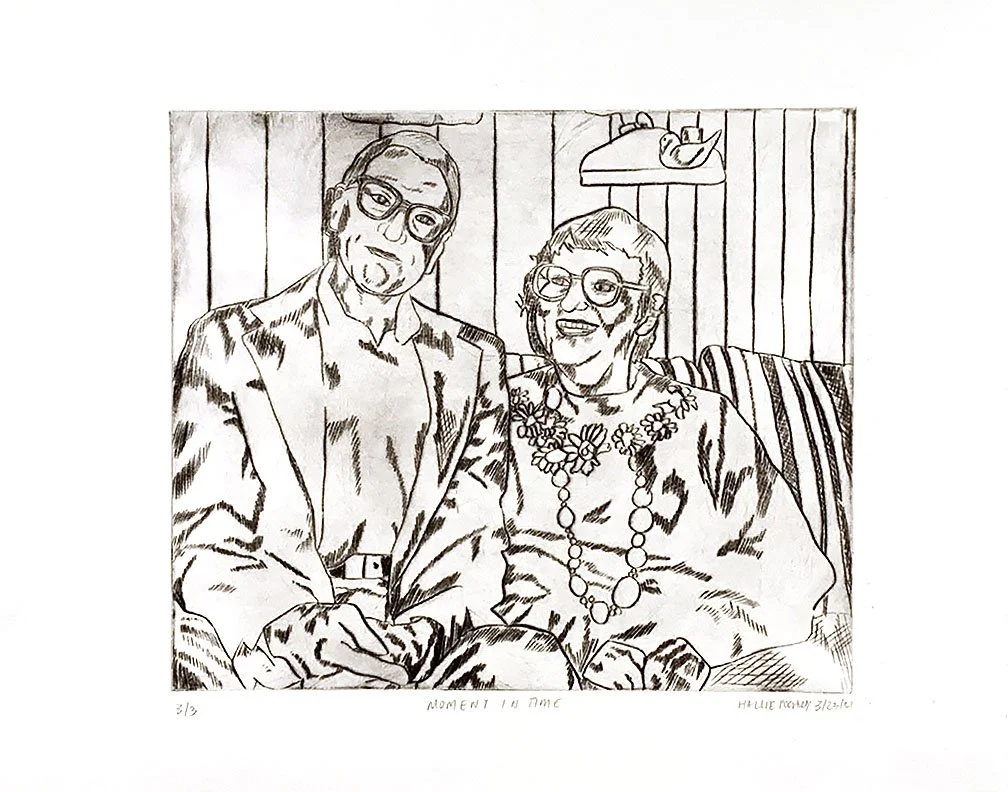
Art: “Moment in Time”
By Hallie Fogarty
What the Morning Takes
The bell rings at three in the morning, not because anyone is late, but because the day has already decided to begin without negotiation.
It hangs from the thick branch of an old plum tree planted at the center of Camp One, a welded piece of scrap metal beaten into a shape that refuses mercy. When it strikes the zinc roofs, the sound travels fast and sharp, bouncing from wall to wall, rattling doors, pulling sleep loose from bodies that had not yet settled into rest. No one ever says they are used to it. You simply stop complaining.
Jacob Mongar sits up before the second strike comes. His body knows the bell better than any clock. Inside the room, the heat has nowhere to go. It presses down from the zinc roof, thick and unmoving, trapping yesterday’s sweat in the air. Wall geckoes scatter along the concrete, their soft clicking filling the brief silence between bell strikes. In the corner, bed bugs retreat deeper into the cracks they know by heart. Mosquitoes hover low, already awake, already feeding.
There is no electricity to interrupt the dark. Night stays complete here, intimate. It presses close.
“Time,” Jacob says quietly.
His son stirs beside him, turning once, then sitting up. The boy rubs his eyes hard with his fists. He is six — old enough to understand the routine, young enough to still feel its cruelty without language. He reaches for his shorts without being told. The body learns before the mouth does.
Outside, Camp One begins to move. Doors creak open. A few weak flashlights flicker, then disappear. Most men walk without light. The path to the rubber fields has been memorized by feet long before it was memorized by the mind.
Jacob pulls on his shirt, still damp with yesterday’s sweat, and reaches for his tools by touch: the tapping knife, the small ammonia bottle tied with twine, the gangan bag folded neatly, the picule stick leaning against the wall like something waiting its turn. They bring leftover food — cold rice wrapped in banana leaf, a piece of dried fish saved from the night before. Nothing warm. Enough to keep the body standing.
They step into the darkness together.
The air is thick and wet, carrying the faint metallic smell of latex long before the first tree is cut. The ground is cool underfoot, softened by rain and years of spilled sap. Roots break the surface without warning. Somewhere deeper in the bush, frogs retreat and insects begin to yield space to the coming morning.
Other families join the narrow path in silence. Men walking slightly ahead, women balancing containers, children carrying what their hands can manage. No one speaks loudly. Sound feels wasteful at this hour. Voices would only remind you how early it is.
When they reach Jacob’s task, the trees stand waiting — rows upon rows of identical trunks, each marked with scars that never fully close. In the half-light, the plantation looks endless, organized beyond mercy. Jacob places his left hand against the first tree, feeling the hardened curve of yesterday’s cut beneath his palm.
He raises the knife.
The blade is dull by design, shaped for control rather than force. He sets it at a shallow angle and draws it across the bark in a smooth, careful motion.
Scrape.
Slide.
Pull.
The bark opens just enough. Latex beads, white against brown, then begins to drip toward the metal spout and into the cup below. The sound is soft, patient, almost kind. It does not last.
His son is already ahead of him, four to five trees down the line. That distance matters. Too close and the knife becomes danger. Too far and snakes, scorpions, and hidden roots demand attention. The boy crouches, removes yesterday’s hardened cup lump from the rim, scrapes the cup clean, and sets it back carefully in its place.
Only then does Jacob add the final step — a small drop of ammonia into the cup, just enough to slow the hardening. Too much ruins the latex. Too little turns work into waste.
The boy moves ahead again. Four trees. Five. No more.
Six hundred and fifty trees do not allow admiration.
Jacob moves from one trunk to the next, his body settling into rhythm. Sweat forms quickly, soaking his shirt before the sun announces itself. His shoulder begins to ache early. His wrist remembers pressure even when his mind drifts. He adjusts his grip and keeps going. Stopping is not an option that exists.
The bush lightens slowly. Birds stir. Heat thickens the latex. The sun is not a companion here; it is a deadline. Late tapping means spoiled latex, penalties, lectures that sound like mercy but are not.
By the time the last tree is tapped, Jacob’s breath comes harder. His shirt clings to him. The plantation is awake.
They sit briefly at Jacob’s cup-lump bench — a small bamboo platform shaded by a leaning tree. Every tapper has one. It is not comfort, but it is pause. They eat their cold rice quickly, chewing without appetite. Drink water drawn from the creek that carries latex runoff, washing water, and human waste alike. The taste is known. They drink anyway. Thirst does not wait for purity.
Then the real punishment begins.
Jacob lifts a small collection bucket, already heavy at nearly forty pounds, and moves down the line again. He pours latex from each cup into the bucket, careful not to spill. Spilling means penalties. When the bucket fills, his arms begin to tremble. He carries it back to the bench and pours it carefully into the larger bucket, listening to the thick sound as it settles.
Again.
And again.
Each trip drains something from him. His shoulders tighten. His lower back burns. When the large bucket is finally full, he slides the picule stick across his shoulders. The wood bites immediately, settling into flesh that no longer bruises properly. Pain does not arrive suddenly — it spreads, steady and consuming.
He lifts. Adjusts. Takes the first step.
Latex sloshes with each movement, pulling against his balance. The load swings slightly. His son steadies one side briefly, then steps away. This part must be done alone. The body learns how to walk crooked without falling.
The walk to the weighing station stretches miles. Families move slowly, bent forward, upright, silent. Breath becomes something to ration. Rest is taken standing, forehead pressed briefly to a tree before moving on again.
At the factory yard, men queue. Buckets are lifted onto hanging scales. Numbers are called. Figures written. Latex changes ownership.
Jacob heaves each bucket upward. The clerk writes without looking at him.
To empty the latex, Jacob climbs the narrow planks — slick with residue, no railing, no forgiveness. Everyone knows someone who has fallen here. Broken legs. Broken backs. Work ended without ceremony.
He does not fall.
Today.
By the time they return to Camp One, the sun is high and the smell of processed rubber hangs thick in the air. The camp offers no relief. No electricity. No running water. Just heat trapped under zinc, mosquitoes rising again, geckoes reclaiming the walls.
Jacob lies on the mat, his shoulders burning. His son is already asleep beside him, hands stained pale gray — the color of early labor.
The factory hums in the distance, bright and tireless.
The bell will ring again before dawn.
The trees will wait.
They always do.
Marvin Garbeh Davis is a Liberian writer based in Monrovia. He grew up on rubber plantations where his father worked as a tapper, and his writing explores labor, inheritance, and the intimate costs of endurance. He lives with his wife, Angea, in Monrovia.