

Covers in Conversations
Covers in Conversation is Quibble Lit’s interview series with the artists behind our cover images.
Each installment takes a closer look at the creative process, influences, and quiet decisions that shape the visual work framing our issues—what the artist is noticing, gathering, testing, and returning to. Not just what we see on the cover, but how it came to be.
Featuring Carella Keil - (JUNGLE, Vol. VIIi)
For JUNGLE (Volume VIII), we’re thrilled to feature Carella Keil, a writer and artist whose work feels lush, strange, and mythical. Carella’s artwork, “The Frog Prince,” will serve as Quibble’s front cover for our 8th print volume, JUNGLE. The cover becomes more than decoration; it becomes a visual spell cast over the issue.
In the conversation below, Carella reflects on “The Frog Prince,” the relationship between image and story, and the importance of refining from the raw.
Find more from Carella on Instagram at@catalogue.of.dreams, and look for her poetry collection Undercover Butterfly.
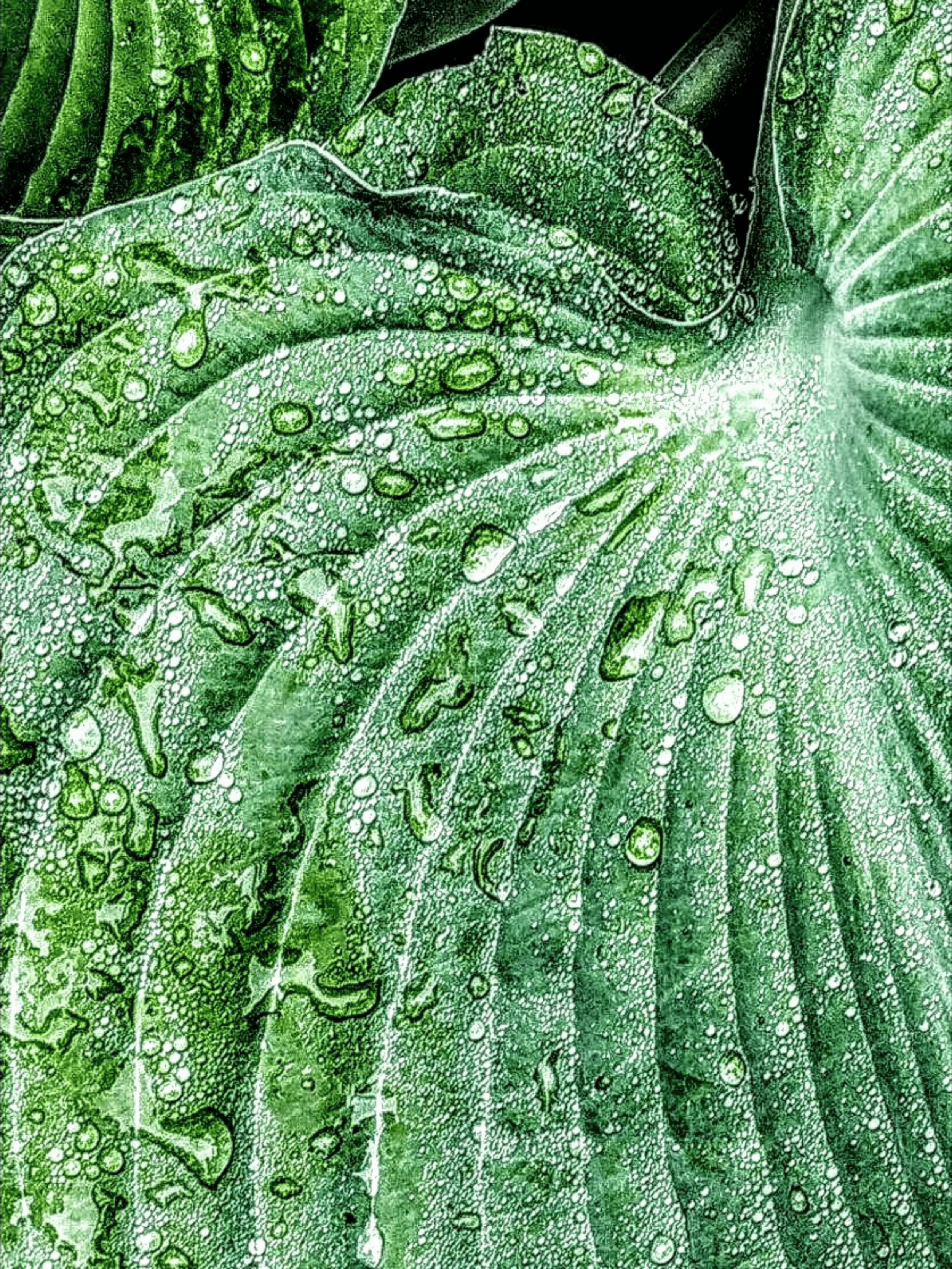
“The Frog' Prince'“
by Carella Keil -
Cover Art for JUNGLE, Vol. VIII (upcoming)
Interview with Carella Keil
1. Can you tell us the story behind “Frog Prince”? Where did the image and story begin?
"Frog Prince" was captured on a photography retreat at a beautiful Victorian house and garden in New Brunswick. The series consists of floral photographs with a dark fairytale motif, so when it came time to name this piece the verdant colors made me think of a frog and the absent Prince.
2. Do you remember what it felt like to hear this piece had been chosen as Quibble’s front cover?
Was there a particular kind of surprise or satisfaction in seeing this image become the first threshold into JUNGLE?
I love how you describe the cover image as being the threshold into this issue, as the first step into a dense wilderness of creativity. I was absolutely floored to receive the news that not only had "Frog Prince" been selected, but it would be the cover art! The news came at a time when I was struggling creatively with the editing process of my poetry collection and two recently accepted short stories, so it provided a much-needed boost to my creative self-esteem. The care and enthusiasm with which Garrett approached this was infectious and made me very excited to be a part of this project!
3. One aspect I enjoy about "Frog Prince" is how its blurred realism and perspective smudges concrete details into abstract forms and textures- and then the title of the work invites us into fairy tale. How did you arrive at that leap from what we see to what the title asks us to imagine?
"Frog Prince" is part of a larger dark fairytale series, which consists of a wilting, rust-colored rose ("Belle"), headboards stacked against a rock cliff ("The Princess and the Pea") and a moss-covered wooden wheel ("Rumpelstiltskin"). When it came time to name this image the leap to "Frog Prince" felt intuitive. The textures and color gradients of the leaf conjure the essence of a frog, droplets of water waiting in suspense for a princess's kiss.
4. There’s no obvious prince here, and maybe not even an obvious frog. What interests you about letting the title transform the image rather than simply explain it?
For me the image is more an abstract idea, I like to play with surrealism in my work, the image in front of us melding into a poetic idea rather than a concrete visual portrayal.
5. What kind of atmosphere were you chasing when you made it?
A dreamy garden, misty slumber, haunting suspense and lush colors you can taste with all your senses.
6. In what ways or parts does this work evoke JUNGLE, to you?
The colors and subject of the image capture the lushness of a jungle, but beyond the physical, there is the idea of a hidden jungle of emotions, yearning and thoughts, the Prince that may never arrive or perhaps has already vanished, the unpredictability, the dangers and potential poison these literal and metaphorical jungles hold.
7. Tell me about the use of scale in your work. Do you often work by making the overlooked feel strange, mythic, or larger than itself?
I definitely like to capture and magnify the strange in images that are otherwise concrete, to take an every-day image and inject it with an element of dream, of the not-quite-real, to bend the viewer's imagination a little bit and allow them to peer into an alternate reality.
8. Quibble’s Featured Ekphrastics invite writers to respond directly to the cover art. What is it like to hand an image over to poets and prose writers, knowing they may find stories in it you never planned?
I am very excited for poets and writers to find stories in "Frog Prince" I never planned. I am delighted for my image and title to spark others' imaginations and to hear all the ideas it evokes! I love the collaborative process of this. For me true art is not what is simply on the page, but what is conjured in a reader and viewer's mind. We are the true works of art, and the permutations from a single image or idea are infinite.
9. What would you love for a writer to notice in this piece? And what would you be delighted for them to completely invent?
I would love to hear not only about the moment of the leaf, but it's past and future, what stories it is a part of, what the jungle contains and what kinds of fairytales it can be woven into. Already my mind goes to ideas of Jack and the Bean Stalk (or a stalker) and poison kisses, and I'm excited to see what the title and image evoke for others.
10. You also recently published a collection of poetry, Undercover Butterfly, with Dark Thirty Poetry Publishing. What has that process been like? When did it begin, and where is it now?
I was approached by Adam Shove, the founder and editor of Dark Thirty Poetry Publishing, in March 2025 to put together a poetry collection. The idea was intimidating but I knew I had to do it and that it was time. I have been publishing my poetry, stories and photographic art in literary journals for 4 years now, and with over two hundred publications and over a dozen cover art features, I knew it was time to consolidate some of my work into a book I could call my own. "Undercover Butterfly" is a personal inventory, a labyrinth of past heartaches and mental journeys, and now on the other side of it I feel ready to share this poetic and personal archive.
11. Does releasing writing feel different from releasing visual art, or are they part of the same creative weather?
Releasing writing feels extremely different to me than releasing visual art. Although a lot of my art is abstract portraiture, there is still a vulnerability and nakedness in writing that I don't find with visual art, even with very raw and personal images. I find art can be curated to evoke a certain emotion or draw the eye in a certain way, whereas with writing you are completely at the mercy of the reader's interpretation and taste. When I share my writing I feel like I am inviting the reader into a wound, and to dig around within it; with art, the wound may be there but it is no longer open, the very act of creating the image has sealed it for me.
12. What's something you wish you learned sooner?
Editing. Editing and more editing. I really underestimated the need for and power of editing while putting together my poetry collection, and going into my second book (a flash fiction collection) I realize how imperative this will be, not only for each individual piece but for flow and thematic consistency (and my publisher's sanity) throughout the pieces, and the importance of avoiding repetition and making sure each scene feels new and relevant to the reader.
Interview with Devon Balwit — (PEOPLE, Vol. VII)
Covers in Conversation is Quibble Lit’s interview series with the artists behind our cover images.
Each installment takes a closer look at the creative process, influences, and quiet decisions that shape the visual work framing our issues—what the artist is noticing, gathering, testing, and returning to. Not just what we see on the cover, but how it came to be.
For PEOPLE (Volume VII), we’re thrilled to feature Devon Balwit, a cartoonist and poet who walks in all weather. Her most recent collection, Spirit Spout (Nixes Mate Books, 2023), storms through Moby-Dick. When she isn’t making art, Devon edits for Asimov Press and Asterisk Magazine, and works with Stripe Press and Progress Magazine—a life lived right at the intersection of image, language, and editorial care.
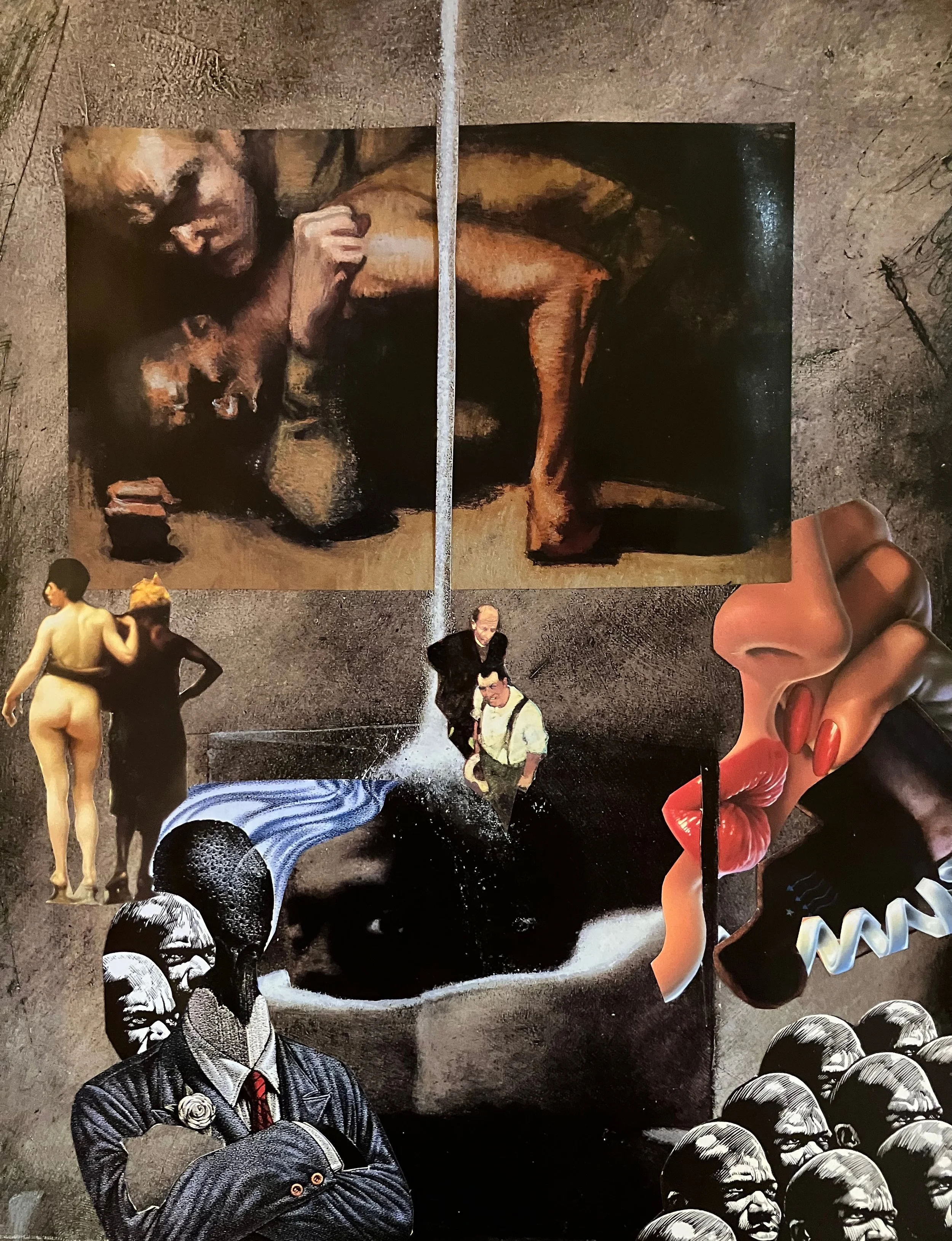
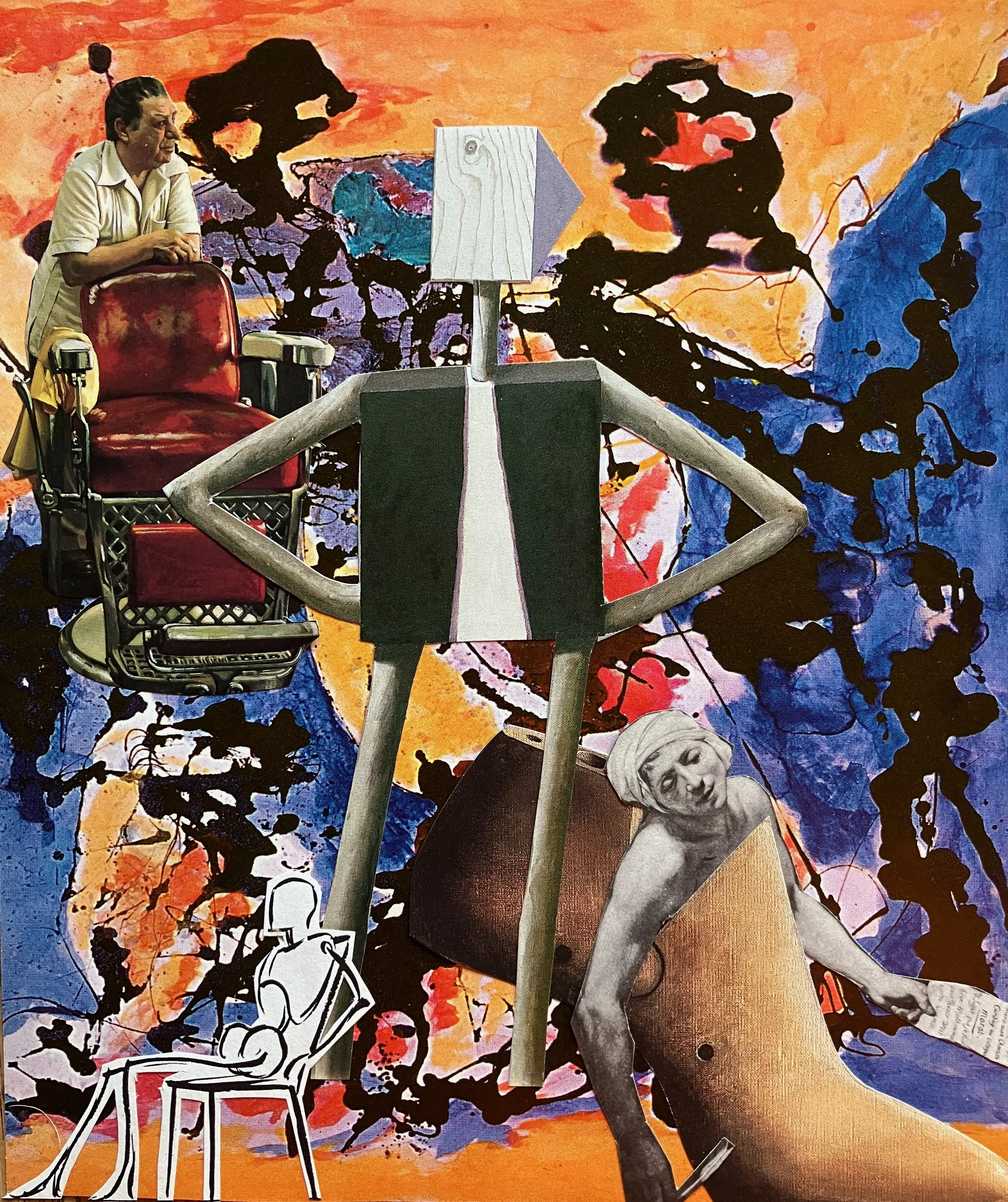
Devon’s two collages—“Smoking” (front cover) and “Shave and a Haircut” (back cover)—mark a first for Quibble: a cover pair designed to work in conversation with a brand-new category, Featured Ekphrastics—bespoke poems written in direct response to the cover artwork.
The result is a kind of call-and-response between visual and verbal composition: texture meeting voice, juxtaposition meeting line breaks, the collage’s logic echoed (and reimagined) in poems - and Devon will also be assisting Quibble with final selections for the Featured Ekphrastics category!
We’ve been incredibly excited to collaborate with such a multi-talented artist—one who has been genuinely generous throughout the process. In the conversation below, Devon reflects on collage as a form of thinking, the editorial instincts that travel between page and image, and how two pieces can speak to one another across the front and back of a book.
Find more on Devon’s website
Interview with Devon
1. Can you tell us what first drew you to collage as a medium? Was there a moment—or a body of work—that made it feel like the right language for you?
I had spent the past two years immersed in life-drawing—taking classes and drawing from nude models studios, but I was getting bored with the process. At the end of the day, I just had more or less accurate nudes in a suite of ever-more-familiar poses.
I journal, and one day in a little free library, I found a book with various suggestions about how to enliven a journal, one of which was to create panels with windows which allow you to look from one page through to another. This led me to collage, as I would create two thematically-linked pages, the top one with peepholes into the bottom.
From there, I moved to single-page collages of all sizes.
2. When you begin a piece like Shave and a Haircut or Smoking, what tends to come first: an idea, a specific image, or the act of looking through source material?
I look through source material—boxes of loose images or piles of art books. Usually, images quickly start calling out to one another: thematically, positionally, or in terms of color. Sometimes, the echo is uncomplicated and, at others, ironic.
3. Where does your source material usually come from, and how intentional are you about the age, origin, or cultural moment of the images you use?
I am lucky to live in a house with thousands of books as my husband is a book dealer / collector. I also live in a town that has many book boxes—I too have one—which offer source material as does our local fund-raising bookshop for the library system.
I can tell you, though, it stops the heart, the first time you intentionally slice into a book—every first cut actually. It feels like violence or vandalism. I have to remind myself that it is a stage in the process out of which another form of art will emerge.
I do feel ambivalence about cannibalizing source material in the sense that I’m aware that I incorporate other people’s work into my collages—yet, so many images go into each collage, and the process of making them is so all-consuming, that I don’t take the time to note and reference each one. I have come to a determination that this is not plagiarism or copyright infringement as my collages are one-offs. I am not creating posters, t-shirts, or objects for multiple sale.
4. Do you think of your work as engaging in dialogue with the past—especially given the historical nature of many collage materials—or as something more present-focused?
I am absolutely in dialogue with the past. Many of my works are ironic revisioning of tropes—whether sexual, religious, racial, etc. (You can see this in “Smoking,” which clearly interrogates both race / gender.) Some of my collages involve literal interweaving of old and new pieces. I do the same with my poetry—one of my collections is my take on Moby Dick. Another, emerged from Flannery O’Connor. Yet another is a collection of sonnets reacting to Sinclair Lewis, Mark Twain, and Henry James. I’ve written reactions to Thomas Mann, Marcel Proust, and Joseph Conrad. I want to digest and metabolize these works.
5. What part of the process feels most intuitive to you, and what part requires the most deliberation or restraint?
Some well-known artists’ images are actually too overdetermined to use. For example, it’s almost impossible to use Salvador Dali, say—as it is so recognizably Dali. Same with M.C. Escher. The same would probably be true for Egon Schiele. I’ve also found it impossible to use well-known children’s book images like Babar for the same reason. They are, essentially, too noisy, and dominate the work. Too, I notice that many modern illustrators’ images are hyper-sexualized. Sexual imagery tends to permeate a piece and reduce subtlety. I don’t just want to titillate.
6. How do you recognize when a collage is finished? Is it a visual balance, a narrative sense, or simply the moment when further changes feel unnecessary?
I’m in a state of flow, a la Mihaly Csikszentmihalyi, when I work. Thus, I sense when a piece is done when the ZAP turns off and I once again become aware of my surroundings.
7. Your collages often bring together figures that seem to exist in different worlds or registers. How much do you plan those relationships in advance, versus discovering them as you work?
I plan many but discover yet more. That’s what I mean about flow state. My subconscious notes that there is classic renaissance triangulation in the figures, say, or that the swoop of an arm echoes the swoop of a tail or of a floral element, or that the eyes of all the figures are chasing one another in interesting ways, etc. I may not consciously set out to make this happen. I love that, in my best work, it always does.
8. These works will appear on the covers of PEOPLE. When you think about that word in relation to your practice, what resonates—or complicates it—for you?
We’re living in a time of tension—our current leaders are fearful of immigrants, fearful of non-binary individuals, fearful of feminists, dismissive of the poor, dismissive of scientists, dismissive of marginalized groups, unwilling to engage in respectful, reasoned arguments with opponents. Additionally, we live in a time where analog activities and face-to-face encounters with strangers are dwindling. People means “a plurality” a “being amongst.” Collage, too, means “a plurality.” You don’t get collage without disjuncture and strange bedfellows. You can’t go into the process knowing exactly what the outcome will be. And, unlike digital collage, cut paper collage is a physical process; one wields scissors, makes a mountain of scraps, gets sticky fingers. You put something in the wrong place and say “Shit! How can I fix that?” We need to be saying the latter—“How can we fix this?” The result might not be exactly what we envisioned, but how can it be salvaged? Who knows?—maybe it’ll be even better.
Featuring Nuala McEvoy — PASTEL, Volume VI
Covers in Conversation is a new Quibble Lit interview series with the artists behind our cover images.
Each interview, we ask for a closer look at the creative process, influences, and quiet decisions that shape the visual work framing our issues.
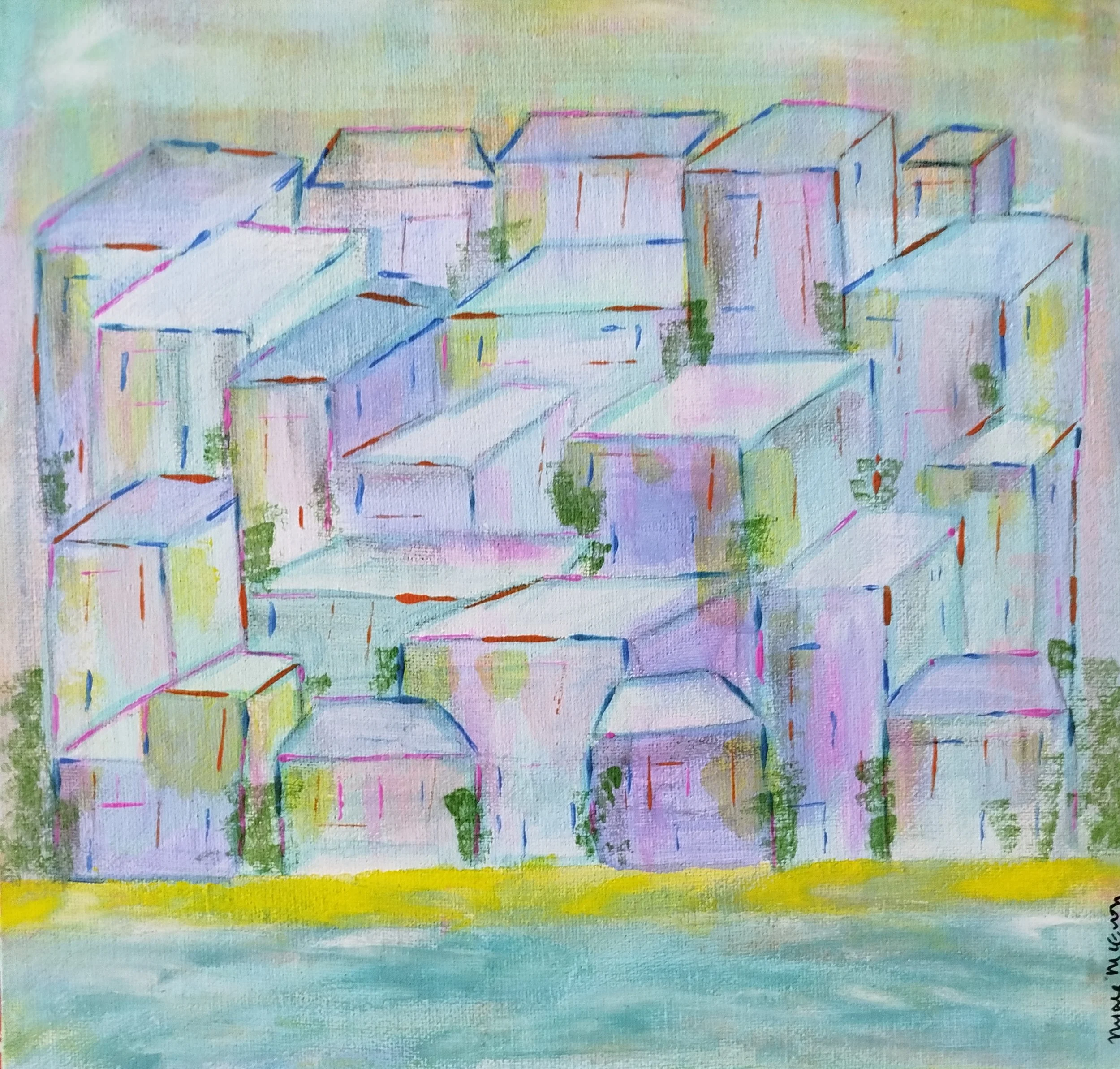
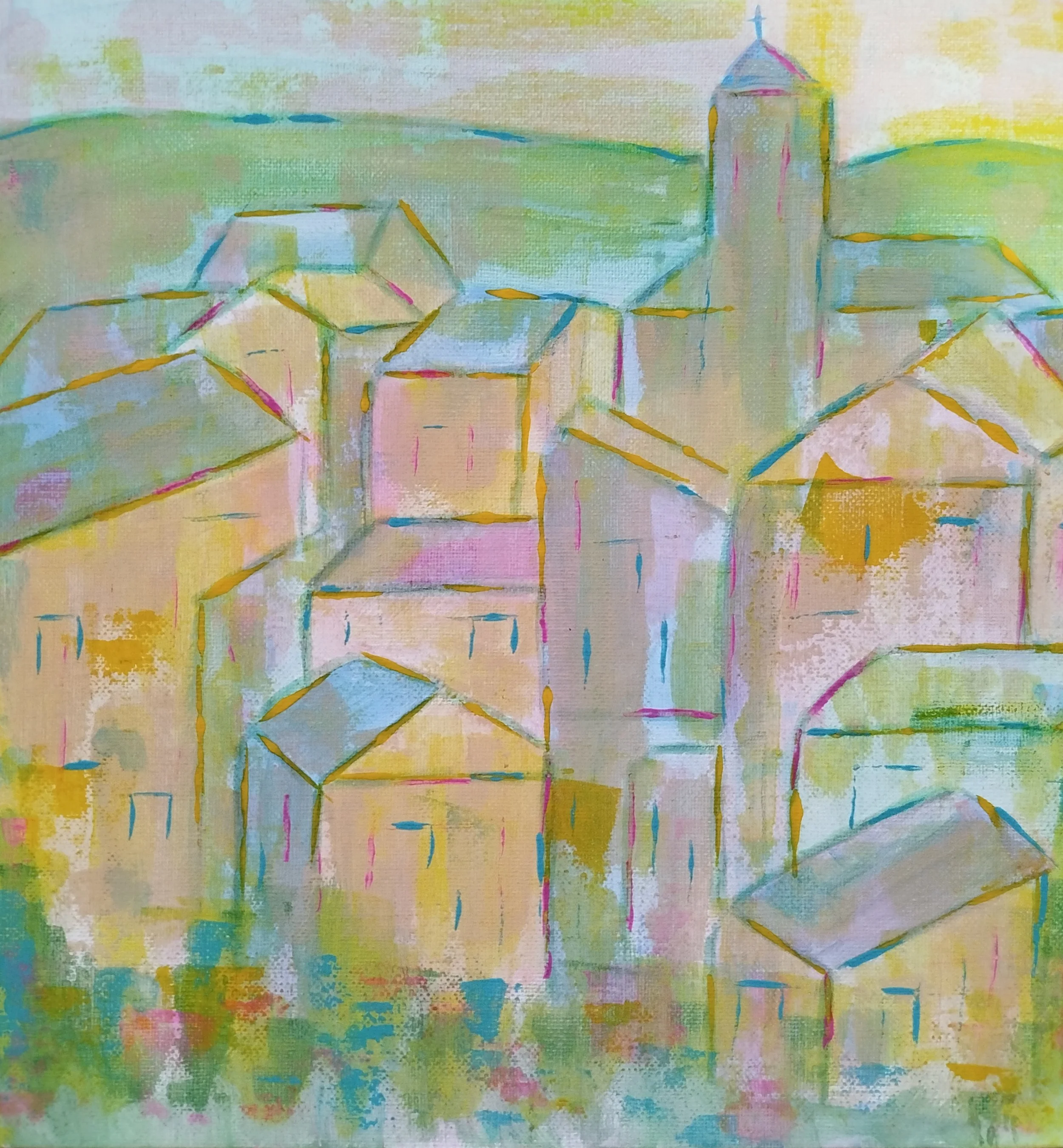
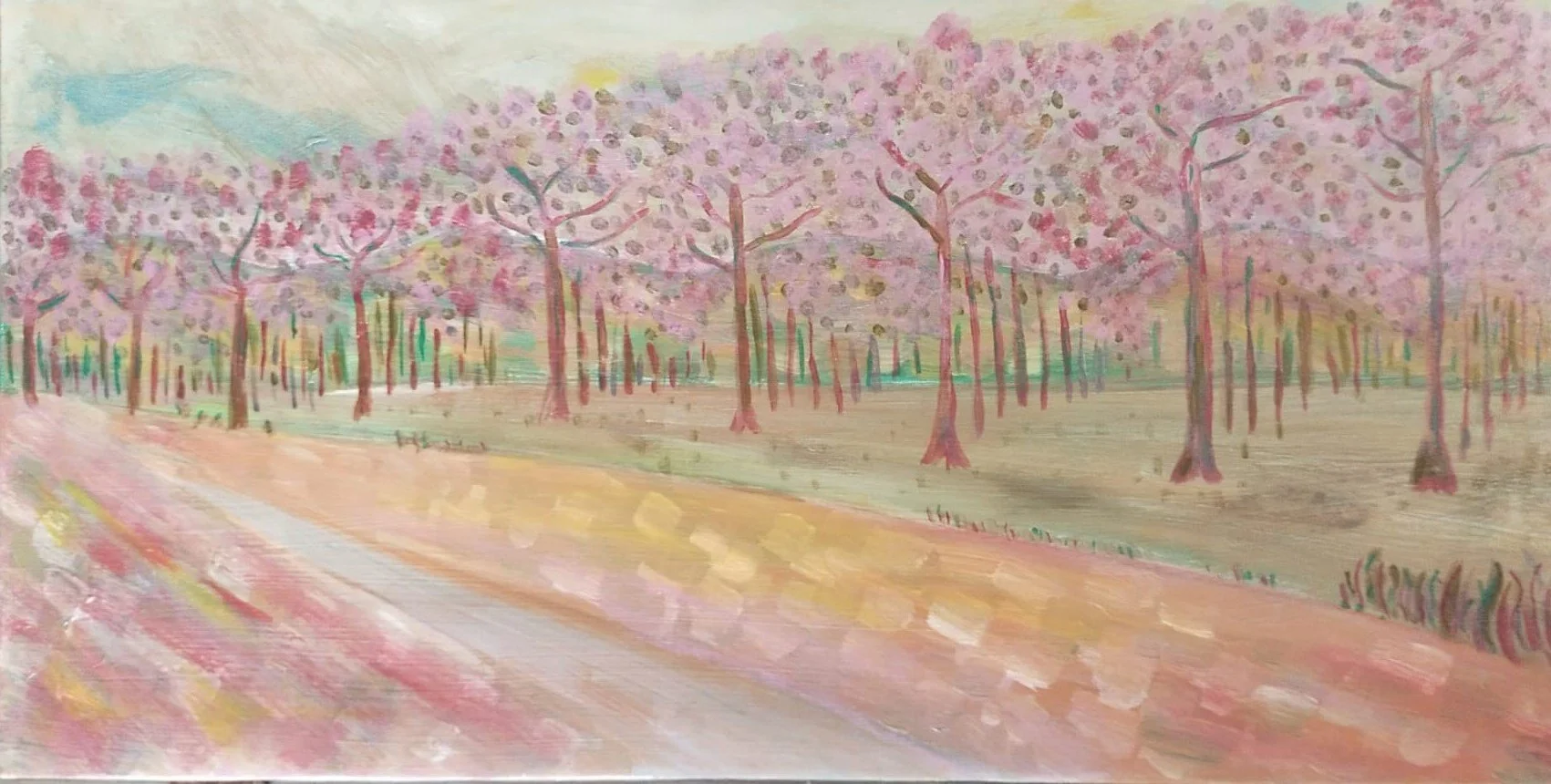
For PASTEL, visual artist Nuala McEvoy brings blurred landscapes and softened forms that hover between memory and imagination — an atmosphere that mirrors the issue’s attention to tone, tenderness, and emotional nuance. In the conversation below, McEvoy reflects on painting as problem-solving, the patience of uncertainty, and what it means to know when a piece is finished.
Interview with Nuala
Q: Can you tell us a little about how these paintings came into being—what was happening in your life, or in your thinking, while you were making them?
A: Right now, I am living in Germany, but my home is in Spain. In terms of landscape, climate, and character, the two countries are both amazing in their own way, but very different. Here in Germany, I often feel nostalgic about the tiny Spanish villages you can stumble across while driving through the countryside or along a coastal road, and I think that is how “Pastels 1” and “3” came into being. They are both blurred visions of different Spanish landscapes. They do not represent any concrete place—just memories that I preserve in my mind.
Q: When you begin a new piece, what usually leads the way: an image in mind, a feeling, or the act of painting itself?
A: I love sitting in front of a blank canvas and not having a clue. The canvas instantly becomes a problem-solving exercise that tests me from the first to the last brushstroke. First, I cover the base with a colour, and then I wait to see what happens. Usually, a plan starts to take form fairly quickly, but sometimes I have to go away and come back to the canvas at a later stage.
Q: Do these works come from memory, imagination, or something in between?
A: These works come from somewhere in between memory and imagination, I think. The borders are almost always blurred.
Q: What part of the process do you enjoy most—and what part tests your patience the most?
A: Each blank canvas is an unknown journey. Often, that journey becomes an intrepid expedition. It is frustrating: the act of painting takes a course that is unexpected and maybe not exactly what I hope for or even like. My patience is tested as I try to steer my work through a different course. It becomes a sort of battle between me and art. I don’t always win. Sometimes I end up with a painting, and I can’t even begin to explain how the process unfolded.
Q: How do you know when a painting is finished? Is it a clear moment, or more of a quiet decision?
A: When it’s done, it’s done. This is the simple mantra that I have learnt to follow through trial and error. When I started painting seven years ago, it was so easy to overpaint or underpaint my work. It was difficult to know when to stop. Now, I sort of know when a painting is finished. It’s just a feeling. If I am not sure, I put my paintbrushes aside for twenty-four hours and come back to look at the painting then.
Q: Could you tell us some of your artistic journey that led to having one of your works featured as a cover for an indie literary magazine?
A: I’m half English and half Irish. I grew up near Liverpool in the UK, and after high school, I studied languages at the University of Durham. After university, I went on to become an English language teacher in Spain. I had no idea that I could paint until much later in life.
I had been politely asked to leave my art class in high school after I had been naughty in class (I was in that horrible too-cool-for-school phase), and since then I had held a certain disdain for art.
After leaving the UK, my family and I moved around a lot, living in places such as Istanbul (Turkey), Ceuta (North Africa), and Craiova (Romania), as well as many cities within Spain. Being on the move, raising a family, and working didn’t give me much time or inclination to indulge in my creative side.
The pandemic period—coinciding with me entering my fifth decade—was my awakening. I suddenly had so much free time on my hands. I taught myself to write to entertain myself, and I invested in a set of acrylic paints, some canvases, and a few brushes. I enjoyed writing, but I was instantly smitten with painting, and my fascination with paint took its own meandering course.
I paint every day now. However, initially, I was very shy about showing my work. Having had no formal training of any sort, I was hugely critical of my paintings and lacked confidence in myself.
After a great deal of trepidation, I started submitting my paintings for review in 2024, and I was flabbergasted by the amount of positive feedback I received. In fact, one of the reviews that cheered me on in the early days was Quibble Lit. Having three paintings accepted for Quibble Vessel gave me a huge boost—thank you, Garrett.
Being published by several magazines gave me the courage to look into exhibiting my work. I have since had two exhibitions in Germany, and I currently have an exhibition of forty pieces at Cavendish Venues, 44 Hallam Street, London. In 2025, my art was nominated four times for Best of the Net. At the moment, I am preparing to display more paintings here in Germany.
Creativity is an unexpected journey, and I can’t wait to see where it takes me in 2026 and beyond.
Q: If one of these paintings could speak for itself, what do you think it would say—or refuse to say? If it were music, what might it sound like to you?
A: I’m going to quote Calderón de la Barca here, as I think this passage from his most well-known play reflects how I feel about my paintings:
“¿Qué es la vida? Un frenesí.
¿Qué es la vida? Una ilusión,
una sombra, una ficción;
y el mayor bien es pequeño;
que toda la vida es sueño,
y los sueños, sueños son.”
As a piece of music, we would have to listen—and bop and sing along—to the lyrics of “Soñaré” by the Spanish band La Oreja de Van Gogh. I’ll leave you to find and translate the beautiful lyrics.
https://youtu.be/WxMuAK4h5Hs?si=lh1GxuorXY63JIt7
Q: What’s something about your work—or your process—that people almost never ask about, but you wish they would?
A: I am going to rephrase this question, if that’s okay with you, Garrett.
What’s something about your work—or your process—that people ask about, but you wish they wouldn’t?
Long before I started to paint, I asked a good friend about her father’s art. John Edgar Newton was an incredible artist—probably a genius. My blunt question was, “How many paintings has he sold?” She replied, “None,” and I was shocked.
She earnestly tried to explain that the sale of a painting was not the measure of success for an artist, and I couldn’t even begin to understand. Now that I paint, I fully comprehend.
Yes, there is a little high when somebody wants a painting or compliments my art. Yes, it’s a thrill when a review wants to publish a painting. Yes, it’s wonderful when someone wishes to display my art. However, I have learnt that art is so much deeper than that.
It’s quite difficult to explain, because the feeling is so intangible and even whimsical, but the real satisfaction in my art lies in producing a piece that embodies something impalpable but meaningful—far removed from anything material.