

The 2026
Ps & Qs Audio Poem Awards
Quibble Lit is proud to launch a new annual Award series designed to uplift contemporary poetry that leaps off the page.
The Ps & Qs Audio Poem Awards recognizes exceptional poems that thrive through breath, cadence, presence, and performance—work that embodies the irreplaceable intimacy of the spoken word.
Unlike traditional page-centered contests, all submissions are audio-only and judged solely on the strength of their sonic craft.
Poets are invited to submit two-minute recordings that lift their writing “above the fold”—pieces shaped by rhythm, texture, resonance, and the physical act of voice.
The Ps&Qs Audio Poem Award builds on Quibble’s 2023 Phonetic Quality Contest, a pilot that revealed just how deeply poets and listeners connect through sound and performance.
This year, we’re expanding that spark into a full-scale, juried award aimed at becoming a meaningful new standard in contemporary poetry.
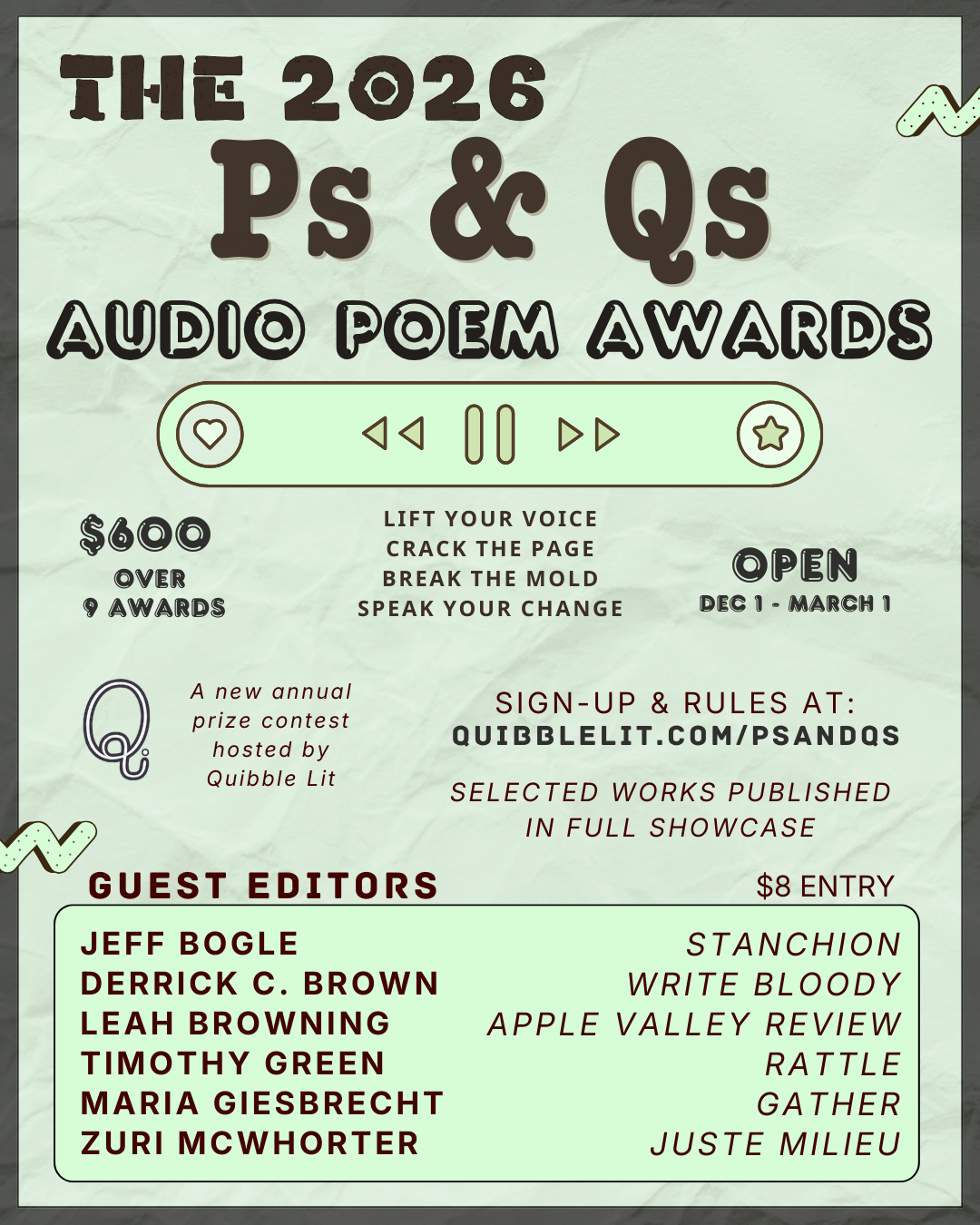

The award features 3 Finalist Prizes:
$250 for 1st Place (Gold)
$125 for 2nd Place (Silver)
$75 for 3rd Place (Bronze)
Alongside these 3 exceptional audio poems, we’ll recognize six Superlative category Winners, each recognizing a distinctive sonic or poetic achievement:
About the Award
Most Humorful
Most Heartbreaking
Most Phonetic
Most Haunting
Best Sonic Experimentation
Best Use of Silence
Superlative winners receive publication, a $25 prize, and inclusion in the Ps&Qs showcase.
Winners and finalists will be featured in a multi-platform audio showcase, with an option to submit video performances.
Submission Window: December 1 - March 1
Sonic Delivery: breath, rhythm, pacing, clarity
Voice & presence
Craft: language, structure, originality
Emotional or atmospheric impact
Performance & embodiment
How strongly the poem succeeds as an audio performance
What We’re Listening For
Judging is blind and based entirely on the audio experience.
Once submitted, all audio files are anonymized and scrubbed of metadata by the Organizer (Quibble Lit ) before our panel of Guest Judges receive them.
The 3 Finalists Awards will be selected by a six-judge panel representing performance poetry, editorial craft, indie publishing, and contemporary poetics.
How Judging Works
How to Record & Upload an Audio Poem
You don’t need a studio — a phone in a quiet room is enough.
We’re here for the poem and its performance.
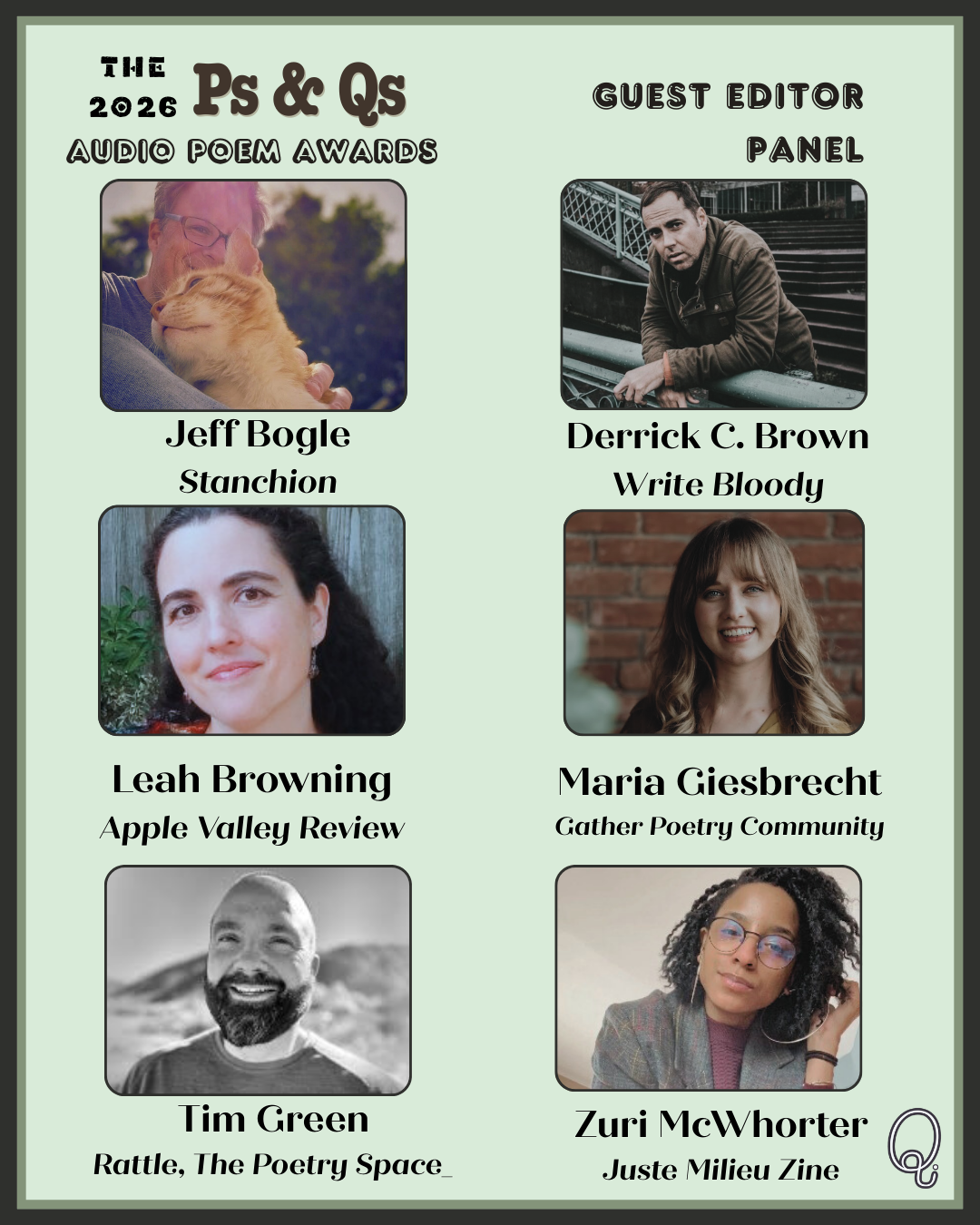
Meet the Guest Editor Panel
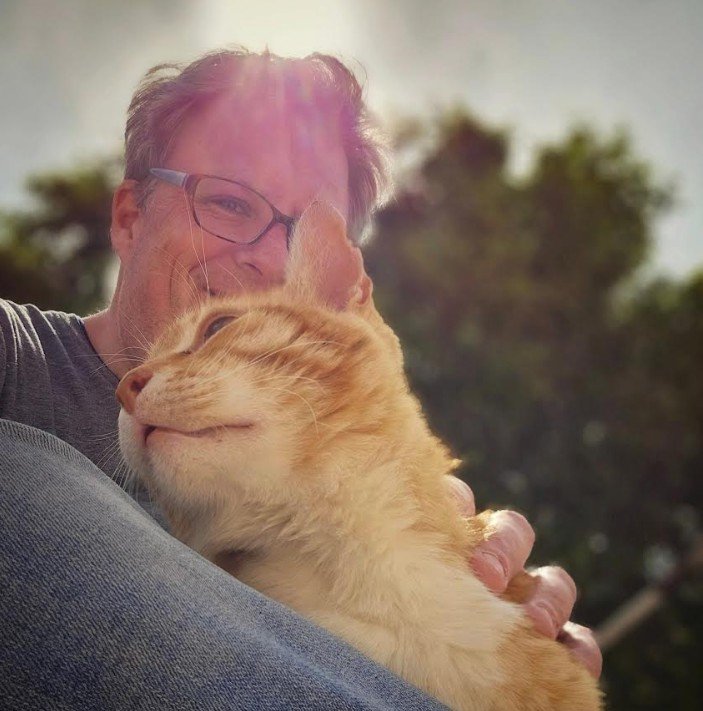
Jeff Bogle is a dad of daughters--two human, four feline--an award-winning photographer, and a freelance writer who lives in the suburbs of Philadelphia. He's written for the BBC, the Washington Post, Good Housekeeping, Esquire, Travel + Leisure, Fodor's, and Wine Enthusiast, among other print and online publications. Jeff is also the founder and editor-in-chief of the quarterly literary magazine and book press, Stanchion. His travel book, Streets Cats and Where to Find Them, was published by Running Press in August 2025.
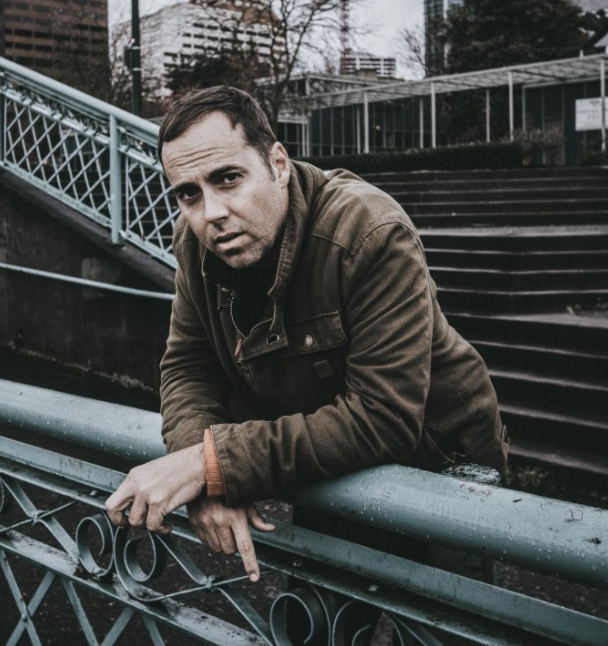
Derrick C. Brown is a poet, publisher and former Paratrooper. He is the poet laureate of Los Feliz, CA. His album, 'A Close Shave with Heaven' earned him Paste Magazine's '2023 Album of the Year.' Winner of the Texas Book of The Year award for Poetry, owner and president of Write Bloody Publishing, hailed by Forbes and Filter Magazine as one of the nation's premier independent poetry presses with a sister company, Write Bloody North in Toronto and Write Bloody UK in London. He has authored ten poetry books and four children's books.
His newest collection launched Dec 5th, A Little Grief Break.
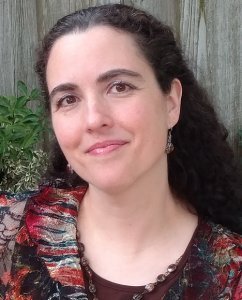
Leah Browning is a writer and editor of the Apple Valley Review (est. 2005). She is the author of two books of short fiction, Two Good Ears and Loud Snow (Silent Station Press), and the poetry collection When the Sun Comes Out After Three Days of Rain (Kelsay Books). Her work spans short fiction, poetry, and humor, with recent pieces appearing in The Haven, Plumwood Mountain Journal, Vestal Review, New Pop Lit, Bear Review, Passages North, Gone Lawn, Waxwing, Terrain.org, and Autumn Sky Poetry Daily, among many others. Browning’s writing has been widely reprinted, featured across journals and online venues, and her books are available through Powell’s, IndieBound, Bookshop.org, and major booksellers.
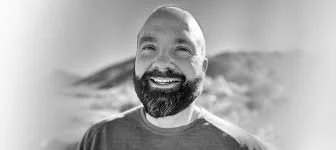
Timothy Green is an editor of Rattle magazine, host of the weekly Rattlecast and Critique of the Week, and co-host of The Poetry Space_, with his wife, Katie Dozier. His radio programming has aired on KPFK-Los Angeles and his articles on poetry in the Press-Enterprise newspaper. Green is the author of American Fractal and Hot Pink Moon, which was co-written with Katie Dozier. He’s also the co-founder of the Wrightwood Arts & Wine Festival and the Wrightwood Arts Center. Find him on X @timothygreen.
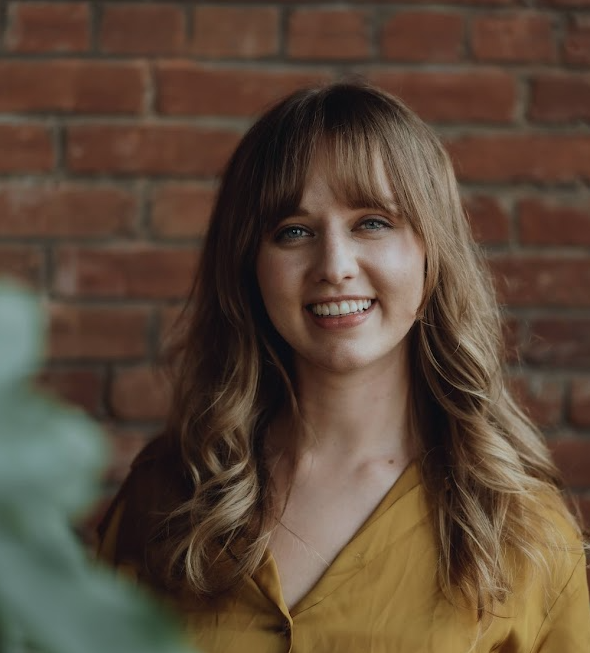
Maria Giesbrecht is a Canadian poet whose work explores her Mexican and Mennonite roots. Her writing has appeared or is forthcoming in The Literary Review of Canada, Narrative, Grain, CV2, Queen's Quarterly, and elsewhere. She is the winner of the 2025 Lesley Strutt Poetry Prize and the 2025 Jack McCarthy Book Prize, a finalist for the 2025 Narrative Poetry Prize, a Best of Net nominee, and the founder of Gather, an international writing community that connects poets worldwide. Born in Durango, Mexico, she now lives near Toronto, Canada with her fiancée. Maria's debut collection, A Little Feral, will be published in May 2026 with Write Bloody Publishing
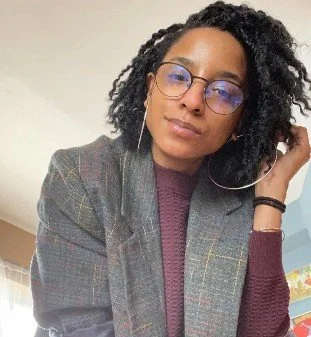
Zuri McWhorter is a writer, editor, and artist from Detroit, Michigan. Her work explores the emotional extremes of human existence, and her writing has appeared in Coffin Bell, Blue Nib, In Parenthesis, and Abandon Journal. She’s drawn to work that challenges comfort zones and leaves a lasting impression. Zuri is the one-woman team behind Juste Milieu Zine, an arts and literary print publication, and the author of two chapbooks.
Guiding Videos
Submitting an audio poem doesn’t require a studio, a specific style, or prior experience with recording. These short videos are offered as guides, not rules — meant to demystify the process and help you feel comfortable sharing your work.
This practical walkthrough covers the technical basics of recording and submitting an audio poem — including simple setup tips, file formats, and what to expect during the submission process.
This short video features an example audio poem, written and performed by Quibble Lit editor-in-chief Garrett Souliere.
It’s shared as a reference point, offering a general sense of what a submission might look and sound like. Your work does not need to resemble this piece.
WHAT TO SUBMIT
We accept one audio poem per entry.
Audio Requirements
Length: Poem recording up to 2:00
You may include up to 15 seconds extra for title only (no other spoken info)
Total file length must not exceed 2:15
File formats accepted: MP3, WAV, M4A
No background music, sound effects, or multitrack mixing
Light noise reduction / leveling is fine
Transcript (Required)
Please upload a written transcript of your poem (PDF or Word). Transcripts are not shared with judges — they are used only for accessibility and captioning.
Multiple Entries : You may submit multiple poems; each requires its own entry and fee.
Eligible Work
New, unpublished audio recordings
Submissions must be in English
Print-published poems are allowed only if the audio is newly recorded
Not Eligible
AI-generated text or AI voice performance
Audio previously published anywhere public (podcasts, YouTube, social media, etc.)
Poems containing identifying information spoken aloud
Work edited with multitrack audio production or added soundbeds
Guidelines
FAQ
What kind of poems are you looking for?
Poems that come alive in audio: strong voice, dynamic pacing, rich sonics, emotional presence, and thoughtful performance. Any style, genre, or tradition is welcome.
Can I submit a poem that’s been published in print?
We would 100% love an original, never-before-seen poem. If the poem has been previously published, please share and make sure all parties involved are consenting.
How strict is the 2-minute limit?
We allow a 15-second window for sharing the Poem Title only - please, NO identifying information in the audio recording. Files must be 2:15 or under. Anything exceeding the limit may be disqualified.
Do I have to read the poem myself?
Yes. The poem must be performed by the poet. (If you have accessibility needs, email us and we’ll determine a fair accommodation.)
Can I add music or sound effects?
No. Voice-only recordings are encouraged. Light room tone is fine, but no added music, effects, or multi-layer mixes. The focus should be the poem’s voice and presence.
Do the judges see my name?
No. All judging is fully blind.
We remove all metadata and identifying information before your poem is reviewed.
Can I submit more than one poem?
Yes! You can submit as many poems as you like. Each poem requires its own entry and entry fee.
Can my entry win both as a Finalist and a Superlative Award?
No - while our finalist selections will certainly possess qualities found in the Superlatives, the Category Awards are aimed to add extra recognition & opportunity.
What are you judging on?
Judges will consider:
Sonic quality (cadence, clarity, breath)
Performance and presence
Poetic craft
Originality
Emotional or intellectual impact
How well the piece thrives as audio
Do I need a perfect, studio-quality recording?
No. A quiet room and a phone are more than enough.
What if my audio has a small mistake—can I edit?
Basic trimming or volume leveling is totally fine.
No auto-tuning, no multi-track editing, no music beds.
Do I need to include a transcript?
Yes. For accessibility and captioning.
But judges will not see it during blind review.
When will winners be announced?
April 2026. Finalists will be contacted by email before the public announcement.
What happens if I’m a finalist?
You’ll have the option to:
Submit a video performance for publication
Submit a re-recorded audio version if desired
This is optional, not required.
Can I submit a poem that is in a regional accent, dialect, or in another language?
For our inaugural year, the Award will be focused on English poetry, but in proceeding years the aim is to expand. All dialects, accents, and mannerisms are welcome.
Is simultaneous submission allowed?
Yes. Please withdraw immediately if accepted elsewhere.
Do winners get paid?
Yes.
1st: $250
2nd: $125
3rd: $75
Superlative: $25
All finalists receive publication
Who are the judges?
Jeff Bogle — Stanchion
Derrick Brown — Write Bloody Publishing
Leah Browning — Apple Valley Review
Maria Giesbrecht — Gather
Timothy Green —The Poetry Space_
Zuri McWhorter — Juste Milieu Zine
Can I include trigger warnings?
Yes — you may include a brief content note in the transcript with the title.
Where does the entry fee go?
Toward:
Prize payouts
Judge honoraria
Accessibility preparation
Submittable platform fees
Production of the finalist showcase
Quibble is volunteer-run; fees support the contest.
Who can I contact with questions?
Email: Editor@quibblelit.com
For Full Terms and Conditions, please visit: QuibbleLit.com/PsAndQs/Terms-And-Conditions