

The Loudest Part
by Judith Anne Seaman
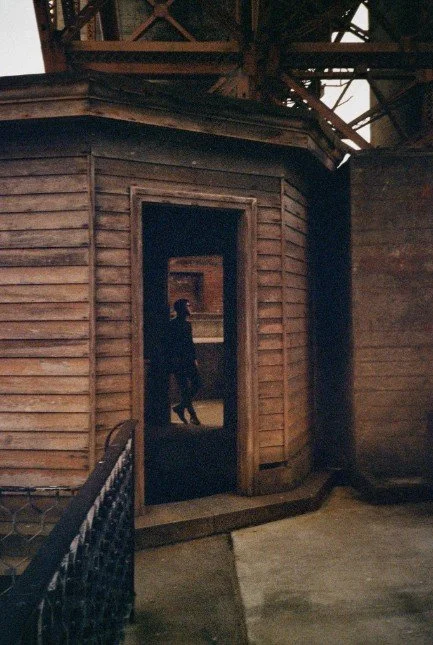
Art: “Fort Point”
By True Levinson
I have an 8mm movie of my mother playing piano where her arms are shaking like a madwoman. I wonder though, who took that little movie because my father wanted the house to be quiet at all times and would never have encouraged the banging of keys. But Beethoven, my mother’s favorite composer, was the one composer, she said, who allowed her to play loudly and this was her one act of defiance when my father still lived with us. Beethoven gave my mother the perfect excuse to pound the keys.
She had gone to a well-known music conservatory, and nearly every book in our bookcase was a music book. There were chord books, books of Chopin Sonatas, biographies of famous musicians, and books on conducting. But mostly there was the music of Beethoven and writings about him. My mother and her musician friends had luncheons, as they called them, and when these were held at our house, I was always disappointed when I heard recipes being exchanged, the butcher being criticized, even disappointed at the delight the women took in talking about their children. Where were the references to Beethoven? To his genius and to his tragic life?
But there were times that I heard my mother refer to him as Ludwig as if he had been a colleague. When his hearing was in decline, she said repeatedly, he would bang on the piano to hear the notes better.
In eighth grade, I was part of the dance program and would often stay late after school for rehearsal. Once, in late fall when the streets were already dark at five o’clock, I walked home and when I reached the steps that led down to the subway, I saw my mother, who worked as a bookkeeper for a Persian rug company, taking the steps up. I watched as she entered the flower shop on the corner. I knew that my mother had just enough money for rent, bills, and food but there was nothing, certainly not for flowers. So, when I saw her leave with a bouquet wrapped in tissue paper, my first thought was that the florist had a thing for my mother. But then I wondered if he just felt sorry for her and I couldn’t decide which was better.
When I was twelve, a new family moved into our building. They rented the apartment right above ours and one day I met the woman in the elevator. Her baby was asleep in a carriage. The woman asked right away if I could babysit on weekday afternoons. She would be there, she said. I was between summer camp and school, and I knew the money would come in handy. The next day when I went upstairs to her apartment, the mother came to the door wearing a sheer nightgown and a white satin robe. I looked down and saw that her feet were bare.
The baby’s room was my room, just one floor up. We chatted as she held him in the rocker. At one point, when he got fussy, she lowered the satin robe off her shoulder and opened the top of her sheer nightgown to nurse him. She continued to talk to me as if nothing unusual was happening, but something unusual was happening, and I didn’t know where to direct my gaze. I scanned the room for something to focus on. I tilted my head to read the spines of the three books on top of the baby’s dresser. One was by Benjamin Spock. The others looked like children’s books written in a foreign language. I studied the pattern of the wooden floor and pictured falling through and landing on my bed. For quite a few minutes, I sat looking everywhere but at her, but gradually I stole a few glances. I fell in love that day, in love with this newfound secret no one had ever told me.
Then we heard a loud bang, and I felt the floor vibrate.
The woman didn’t look startled at all but simply asked if that was my mother playing piano. I hadn’t told her anything about my mother and her piano playing.
“Yes, my mother likes to play loud,” I said.
“She plays so well.”
We sat there for another hour. She didn’t once ask me to do anything. She seemed happy with my just being there. When I stood to leave, my lovely upstairs neighbor asked me to get her wallet from her purse whereupon she took out a twenty-dollar bill and handed it to me. The same thing happened every time I left her: after sitting with her for an hour or two, doing nothing, she would take a twenty dollar bill out of her wallet and hand it to me.
Sometimes, she would ask me to stay until her husband came home. Then he would be the one who paid me. As beautiful as she was, he was that handsome, a male counterpart, dark, tall, like the photos in the movie mags I stole from Mr. Levine’s stationary store across the street when he was distracted relighting the cigar his wife tried to confiscate. If Mr. Levine even saw me looking at his magazines, he’d yell, “Don’t touch those!”
The husband always arrived home with a gift for his wife. Often, it was a bouquet of flowers: usually oversized bouquets of roses with lots of greens and baby’s breath. I’d watch as she put the flowers in a large vase then lean down to take in their scent. When it was time for me to leave, the husband would walk me to the front door, the same front door as mine only one flight above and give me more money. He would say something like, “You really are so helpful.”
Most of the time, when I returned to our apartment, my mother and sister would already be sitting at the dining room table.
“Dinner’s getting cold,” my mother would say.
“It’s not getting cold. It is cold,” my sister would add. Then she would smile innocently at my mother and praise her delicious food, which was, without fail, burnt and flavorless.
After the dinner dishes and pots were washed, dried, and put away, my sister would retreat to her room by the kitchen and spend the rest of the night listening to Joan Baez. She parted her hair the way Joan Baez did and managed to borrow a guitar from a friend’s boyfriend. I would hear her strumming softly. She was terrible.
As for me, when I went to sleep, I would think about the woman and her baby, that they were right above me. I imagined how the flat part of her feet might have been resting on her floor at that very moment, just on the other side of my ceiling. How she might be feeding the baby as I was closing my eyes. Another world just above mine.
Summer ended too soon and I went back to school. Sometimes I saw the woman and her baby in the elevator. I never knew what to say. I had seen her in such private moments that I had trouble looking at her.
And then one day, I found out they moved away. To Italy, I asked the superintendent? But he didn’t know.
I’ve thought about them a lot over the years. Once, I thought I saw them in Central Park when I was on a break from school, but we passed each other on the path as if we were complete strangers. I guess in some ways my upstairs neighbors had been strangers to me. And maybe they thought of me that way, too. A few times, I tried to find them, just to see where they were living, but I wasn’t sure of their last name. They were from Italy. That’s really all I knew, and it was so long ago. I’ve often conflated the baby’s mother with Sophia Loren because that is who she looked like, only softer and quieter.
My sister left for college on a train in 1965. The school was in the Midwest somewhere; God’s country I called it. My mother and I took her to Grand Central Station where she would spend two nights on a sleeper train. She looked very cool in her navy-blue woolen Peacoat and her brown leather bag with a wide shoulder strap. I had gone to Mr. Levine’s store and bought a greeting card with a picture of a cat, and wrote, “So long, it was nice knowing you,” plus a pack of cards and a package of Wrigley’s gum. But when I hugged her at the station, I couldn’t let go. “Don’t leave me.” Tears spilled from my face to hers and dripped on the collar of her brand-new coat.
Not long ago, I asked Google for the loudest piece composed by Beethoven and found a YouTube video called ‘Most Badass Passages.’ A man plays sections from each of Beethoven’s nine symphonies. His arms are shaking like a madman's and I’m sure the strings in the piano are jangling, shaking the chandelier above him and the floors of his upstairs neighbors.