

The Grammar of Presence
by Andrew A. Chibi
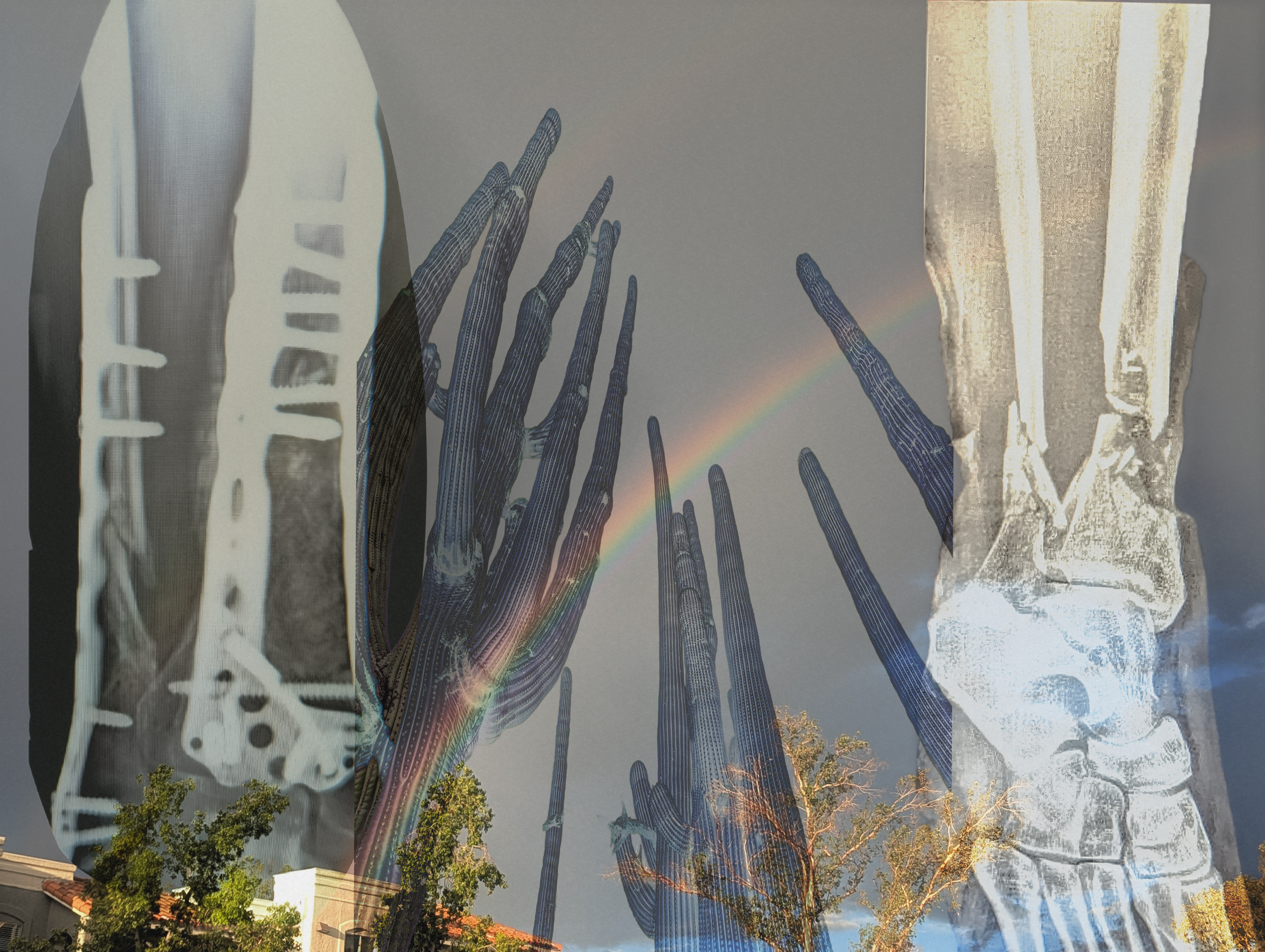
Art: “Metallic Taste”
by Oz Anarchy
Most people assume theological conflict begins with belief. I used to think so too. But the longer I lectured on the Reformation era, the more I realized conflict begins somewhere quieter. It begins with grammar.
By late afternoon, the seminar room always felt a little drowsy. My second-year Reformation class drifted in with the usual mix of curiosity and fatigue. I wrote a familiar sentence on the board—This is my body—and waited. They expected history: Luther and Zwingli, councils and controversies. What they did not expect was to be undone by a verb and a pronoun. It usually began with someone in the middle of the room frowning at the sentence as if seeing it for the first time. “Dr. Martin,” a student would ask, “what does IS mean there?"
The room always shifted around that question.
A hand goes up near the window. "Well, Luther thought it meant is,” the student says. “Like, actually is.” This is said with the earnestness of someone trying to defend a position he isn’t sure he believes.
Another student answers, “But Zwingli said it means signifies. So, it’s symbolic." The first student frowns.
“Then why would Christ say IS?” A quieter voice joins in: “Maybe because it’s not about the bread. Maybe it’s about what the bread points to."
Suddenly, the room is alive. Some students drift toward Luther, drawn to the solidity of taking Christ at his word. Others move toward Zwingli, relieved by the clarity of a symbolic reading.
Then there are the quiet ones. Those students who sit very still, listening as if the verb itself is speaking. One of them raises his hand. “If Christ is in heaven, how can he also be in the bread?"
The room goes silent. The question is no longer historical. It is about the fear of losing Christ, the longing for presence, and the uneasy space between the two. I tell them Christians have argued about this for centuries, but I can see that none of the historical details are what they are really asking for.
They are asking how language carries meaning. They are asking how a small word can hold a mystery.
Another student, one who rarely speaks, finally says, “It feels like the whole sentence turns on that one word. Like everything depends on it.”
The observation is correct. The verb is small, but the questions it raises are not. It is the point where grammar becomes theology, and theology becomes personal. Teaching this has taught me that theological conflict is rarely about abstract metaphysics. It is about the human need for clarity, certainty, and presence. It is about the fear of losing what matters most. The answer depends on who is speaking, who is listening, and what they hope or fear the word might reveal.
The shift from IS to THIS usually happens quietly. Someone stares at the board, thinking they have understood the verb, when the pronoun suddenly bothers them too.
"Okay, but what exactly is THIS referring to? The bread? The meaning of the bread? The whole moment?" I explain that Luther anchored the mystery in the physical object held in Christ’s hands, while Zwingli pulled it toward symbol, arguing that a body in heaven could not also be on the table. Then I'd add how Karlstadt tried to shift attention away from the bread entirely and toward the meaning of the moment. "Each reading changed the sacrament."
A student near the window observes, “It’s strange that such a tiny word can divide people who agreed on almost everything else."
"I agree." I will then explain how the pronoun directed attention. How it told us where to look. And looking, it turned out, was never neutral. Not every reformer pulled the words apart. At this point I would introduce John à Lasco into the discussion.
Lasco was more pastor than systematizer (referencing Calvin or Melanchthon). "He argued that the phrase had to be taken as a whole. The meaning was not in the grammar but in the act itself—the gathered table, the shared meal, the receiving."
When I told the students this, one of them would invariably say, “So it only makes sense if you’re there."
The room would go quiet. The students realized that we were no longer only analyzing a sixteenth-century argument. They were discussing such things as presence, participation, and what it means to receive something rather than simply understand it.
Eventually someone asked the harder question: “Which body is he talking about then? The body at the table? The body about to be broken? The body that would be raised?"
One of the quieter students, generally, would comment, almost under their breath, “It feels like the noun is where the whole thing becomes real."
I would agree that they were correct. The debate had moved from grammar to suffering, from interpretation to cost. Here is where I would introduce Oecolampadius.
"He had insisted that Christ referred to the visible body that would soon be broken on the cross—not an invisible essence hidden beneath the bread, but the body that bled and died. The bread pointed toward that body, not to a hidden substance beneath its surface." I would then watch the students sit with that weight. It was no longer only about what the reformers believed. It was about what it means to remember a body that was broken.
Near the end of the seminar, a student said, almost shyly, “We haven’t talked about MY." The room paused. The smallest word suddenly felt like the largest.
"It's strange,” someone observed. “We’ve argued about everything else. But no one argues about MY.”
“It certainly makes it personal,” another commented. “It makes the sacrifice his choice.” They were right. MY turns the sentence from a doctrinal claim into an act of self-giving. After all the arguments about presence and symbol, the possessive pronoun remains the quiet center: This belongs to me, and I am giving it to you.I have watched that realization land on students more than once. It is usually the moment the debate stops being historical. The room goes quiet—not out of confusion, but because something has landed. Someone says, almost to themselves, “It’s the smallest word, but it’s the one that feels closest.”
By the time we reached the end of the sentence, the seminar is usually quiet in a new way. The students had discovered that the smallest words carry the largest meanings. Teaching this taught me that theological conflict rarely begins with abstract metaphysics. It begins with the human need for clarity, certainty, and presence. It begins with the fear of losing what matters most.
I am retired now. But every time I taught that sentence—This is my body—I was reminded that the conversation was still alive after half a millennium. The words continue to ask their questions. And every so often, in a late-afternoon classroom, a student still hears them as if for the first time.
Andrew Allan Chibi is a Canadian historian and writer based in Windsor, Ontario. He is the author of several monographs on early modern religion and power, including Fear God, Honor the King and Henry VIII’s Bishops. His creative work explores memory, perception, and the quiet metaphysics of ordinary experience. He has published fiction and nonfiction in a range of literary venues and is active on Twitter/X (@AndrewChibi).