

The First Mortality Tale
by Liesl Jobson
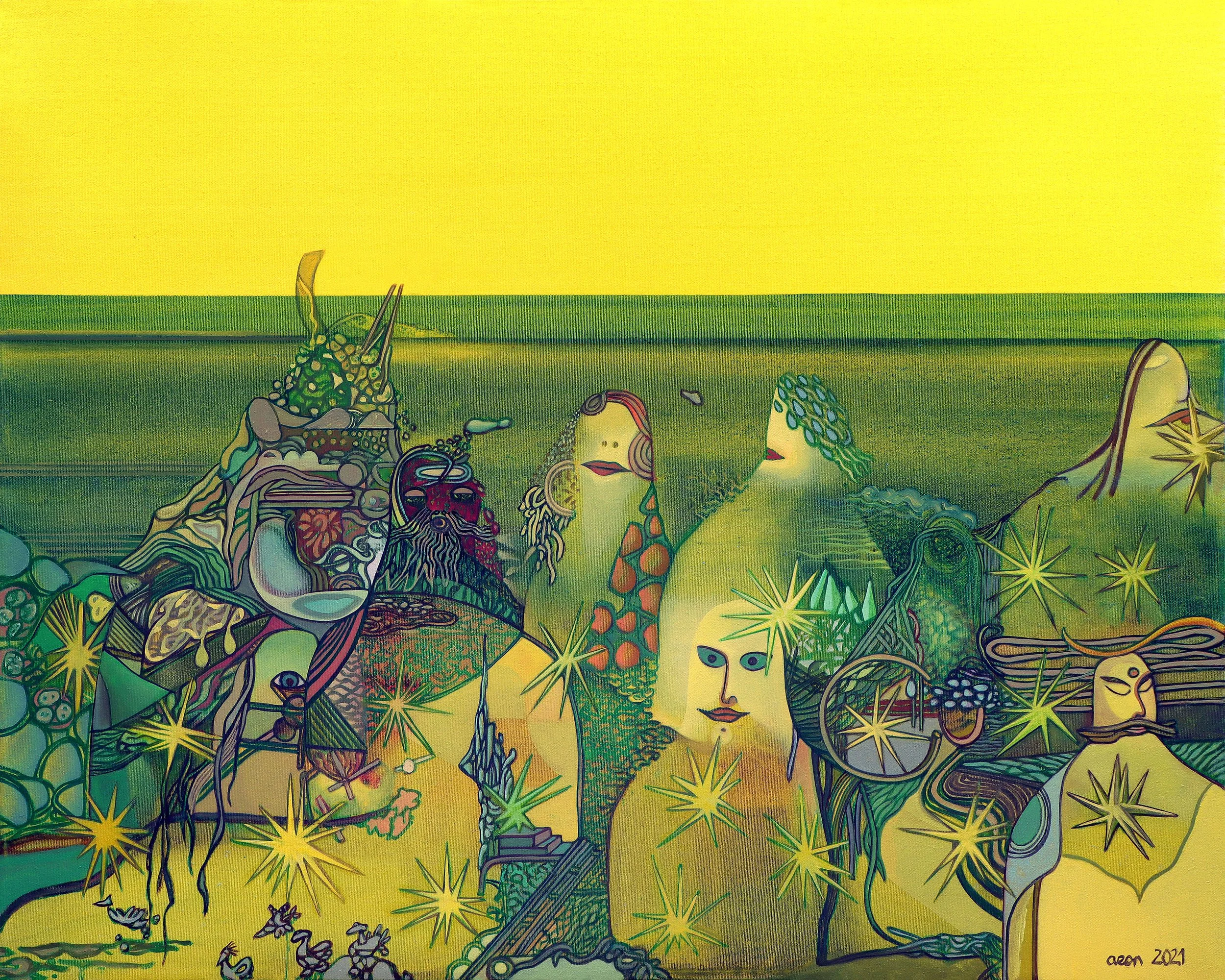
Art: “Bathers”
By Alexey Adonin
My mother seldom told stories, but she told me this one. Once. Once was enough.
Three children go into the woods. The deeper they go, the further they wander from home. The more fun they have, the hungrier they get. Soon they find a perfect picnic spot beside a pretty little stream. They sit down together and the big sister unpacks her satchel. She hands out the delicious sandwiches their mother has packed for them and they drink straight from the clear brown stream flowing gaily through the clearing.
I can’t imagine drinking from the Umbilo River at the bottom of our garden. When we walk down through the tall gum trees that swish in the wind, we watch for mambas in the long grass. Down the muddy bank the water trickles around smooth rocks into stagnating pools which attract mosquitoes and dragonflies. We are not allowed to walk in the water. Never. Not ever. Unless you want parasitic worms climbing into your peehole. The risk of bilharzia is serious but getting rabies from a monkey bite is worse.
One day we discover a rope with a stick tied to the end of it hanging from a branch a long way up. The neighbourhood boys swoop across the river with their legs wrapped around the giant knot at the base of the rope. I don’t trust boys. I also don’t trust myself to hang on properly to a rope swing. Fortunately I am not invited to try it so I can’t fall off midway across the water.
The games in the forest continue and the three children are having a great deal of fun, enjoying the sweet scent of pine needles and the song of the birds. The little brother casts stones into the stream, aiming to make them skip but the stream is too shallow and the stones land with a plop. The little sister tries to hug a tree trunk but her short arms can’t quite reach all the way. She calls her siblings and the three of them can just reach around the tree. They hug the tree, feeling happy.
This story sounds off. Do these siblings not bicker? They seem altogether too happy. I’m suspicious. Also, in our home the mother does not make delicious sandwiches. The big sister makes them and they are not delicious.
As the sun’s rays cast a slanting shadow through the trees the big sister remembers her promise to be home before dark. But where is home? The little brother looks at the path they came along, but it seems to go the wrong way. They walk together in the opposite direction, but the path soon ends in a thick brush.
In summer the pre-dawn birdsong starts at 4.30am and rouses me. I am not allowed to wake up my younger sisters but once it is fully light, I go outside alone and climb the jungle gym that Grandpa gave us last Christmas, the year I started kindergarten at the Regina Pacis Northdene Convent.
The children head back, imagining they are close to the clearing beside the stream. There is no clearing any more, just a winding path that goes on and on. Are they headed home? Are they going deeper into the forest? There is no way of knowing. The shadows lengthen, the light dims. The birdsong grows louder as the birds call goodnight to each other. Soon the birds put their heads under their wings and the forest darkens and falls silent.
Two years earlier, when I was three and Megan was two, our grandmother and her sister, Aunty Erica, visited from Kimberley. While our mother was in hospital having another baby we got onto the train at Sarnia Station and rode all the way to the city. We walked along Durban’s beach front promenade and bought frozen lollies from a vendor. They melted fast and ran down our arms in sticky trails. Outside the City Hall we bought paper twists of birdseed. Pigeons flew down from the statue of an angel with lions crouching at its feet. Granny tried showing us how to hold out flat hands, filled with seed but when a pigeon pecked Megan she got such a fright that she threw down all the seed, crying in surprise. The birds rose up about us, flustered wings beating. Aunty Erica pulled back and bumped into a man passing behind her. Granny pulled out a cigarette and brushed the tears off Megan’s face.
The little sister is tired. The little brother is hungry. “Are we nearly there yet,” they both ask. The big sister is frightened but takes care not to scare her siblings. She says, “Let’s stop now because it is too dark to go on. We’ll huddle together and someone will find us soon.” The children settle under a big tree. The big sister rests her back against the trunk and puts her little sister’s head down in her lap. Soon the little sister is fast asleep.
On the way back to the station we waited at a pedestrian crossing for the light to change. I held Granny’s hand and Megan held Aunty Erica’s. My little sister bent down to pull up her sock. When the light turned green we crossed without her. Only once we were on the other side of the road I saw her standing alone on the curb, trying to see where we’d gone. I tried to run to her but Granny yanked me back, shouting at Megan to wait, shouting at me to stop. It took hours for the light to turn green. Buses and cars roared past. When we got to her, Megan had wet herself and was crying even harder. Aunty Erica shouted at her. Granny shouted at Aunty Erica.
The little brother, who is just a bit older, stays awake a bit longer. “How will we get home?” he asks. “An honest woodcutter will come this way in the morning,” says the big sister, reassuringly.
We were hot and thirsty on the train ride home. We were not allowed to put our heads out the window lest we got grit in our eyes. We walked slowly down the hill to our house beside the river as Aunty Erica’s feet hurt. Back at home there were no cinnamon pancakes. Not even cinnamon toast. When my mother returned back from the hospital she brought us a new sister who screamed and screamed. Mom showed us the circular marks on our new sister’s head and explained that the baby had a terrible headache.
She has heard stories of honest woodcutters rescuing lost children. The brother lays his head on his little sister’s shoulder. The big sister sings a lullaby and soon he is also fast asleep.
The new baby’s screaming gave everyone a headache but Mom needed rest. It was my job to rock the new baby to sleep so that Mom could sleep. I bounced her pram over a fold in the carpet, chanting our names: Liesl and Megan and Catherine. Forward over the lump in the carpet … Liesl and Megan and Catherine… backward over the lump the large rubber tyres bumped. It took forever for the baby to settle. As soon as I stopped to sneak away, the wailing started up again. It seemed it would never end, the jiggling and bouncing of the pram, the chanting of our names. I learned to slow the pram so that the stop was not abrupt. I learned to slow the song so that the baby would fall asleep knowing that she was not alone.
As the moon rose in the east the big sister finally drifted off to sleep. When the birds started singing in the morning a search party arrived, led by the honest woodcutter. Soon all three children were home safely after their big adventure and their mother made them cinnamon pancakes for breakfast, which were, of course, delicious.
The next time my mother goes to the hospital, she does not bring home a baby, but the time after that she does. I carry the baby in a towel on my back like our nanny does. I shake the milk powder in her bottles and hold them at just the right angle so she doesn’t get wind. I read her stories to put her to sleep. I bathe and dress her to help my mother.
There is another ending to my mother’s story…
As the moon rose in the east the big sister kept watch over her siblings protecting them from the cold with her thin arms stretched around them and sweating palms. All night long she shivered in the dark, heart racing at every twig cracking the silence. All night long she stared up at the stars, wondering whether the woodcutter would find them before the wolf did.
Nobody tells me the other ending to the story, but deep inside my five-year-old heart I already know that the big sister will never truly feel calm. She will learn not to panic. She will wear a brave face. But that is not the same as
She will watch over her siblings whenever they get lost and she will tell them the stories they need to hear. In time her own children will wander very far from home. She will watch the stars until they find their own way, or become woodcutters themselves. On sleepless nights she will sing the lullabies that circle until the end of time.
Liesl Jobson writes from Zeekoevlei, a freshwater lake where hippopotamus once roamed. Her writing appears in The Southern Review, New World Writing, Slush Pile Magazine, 3AM, Flash Fiction International, The Common, Lichen, Adanna, Quick Fiction, Schuylkill Valley Journal and Cutthroat Journal. She plays the contrabassoon, coaches women’s rowing, and is a community activist in Cape Town, South Africa.