

Professor H
by Lorraine Comanor
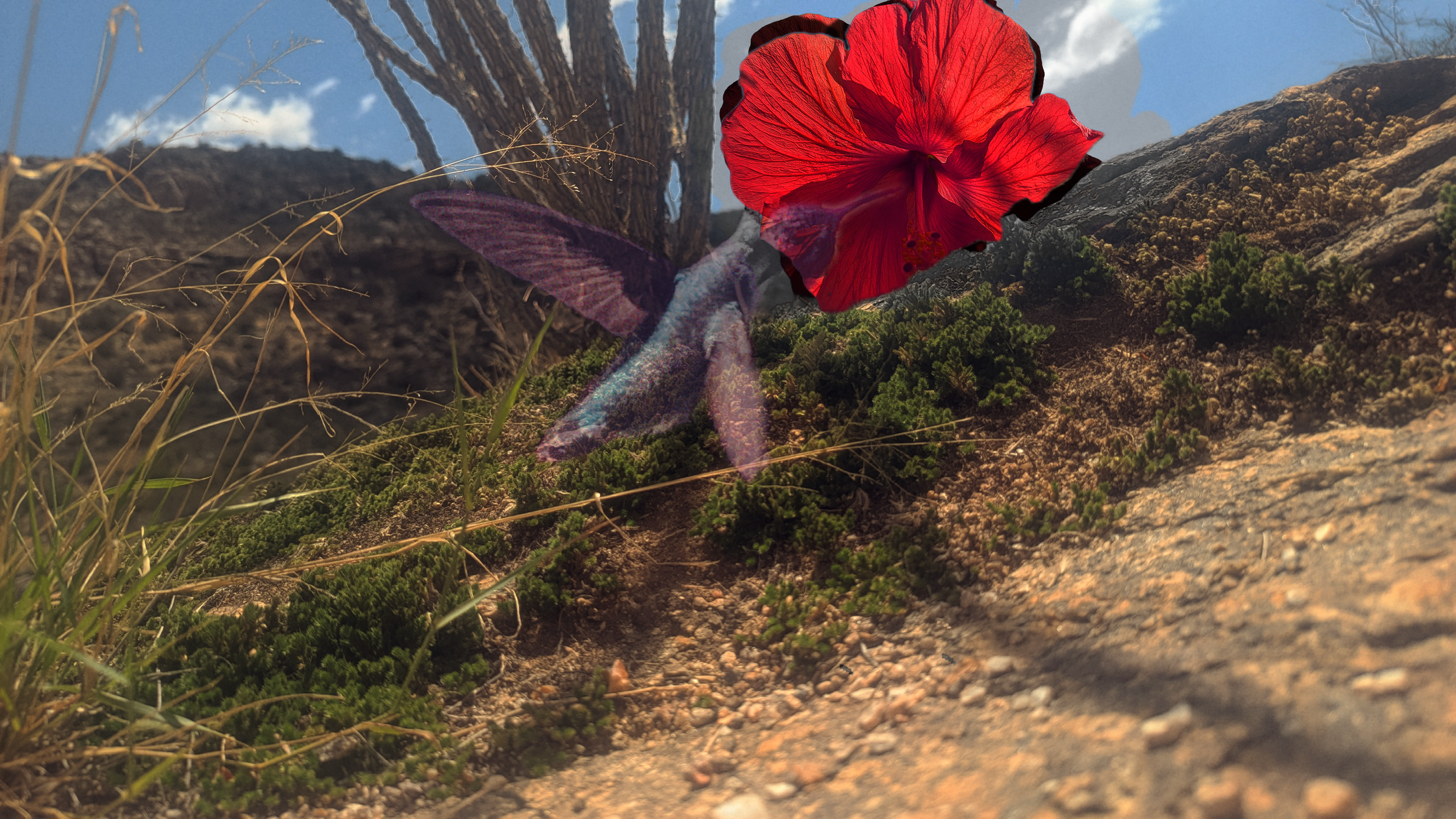
Art: “Echoes 2”
By Oz Anarchy
Trigger Warning
My French history tutor, a humorless man with a cleft chin, hovered in the corner of the windowless cubbyhole Harvard spares for its assistant professors, shrouded in a pink baby blanket. A fierce squash player, he didn’t appear ill, nor had the fall chill taken hold, yet he offered no explanation for his Linus habit, as he stared at me disapprovingly through his steel-rimmed glasses.
Every week we spent an uncomfortable hour together, tutorial being a requisite part of Harvard’s honors history and literature concentration, mine that of 19th century France and Germany. Despite the period constraint, Professor H began our discussions at the end of the 18th century, a time I later realized I saw through my father’s capitalist lens, failing to appreciate Marx’s rendition of the 18th Brumaire, and later, the role of socialism in the 1848 revolutions. Nevertheless, he kept searching for texts that would make me see the light, taking me back to the French Revolution, one of his favorite subjects.
The previous afternoon, after scouring Houghton, the rare book library, for the arcane text on the Montagnards, the radical sect of the Jacobins, we were to tackle at our next session, I’d gone home to the Back Bay when he’d phoned: oblivious to other course work, he’d changed the assigned text on those bloodthirsty fellows. Obtaining his new manuscript entailed two more bus trips across the Charles, a walk to and from Houghton, and probably another hour to find it. I sat in the bus, seething.
During our anesthetizing hour in his prison cell, I imagined picking the pile off his shabby blanket, peeling away at his protection against the horrors of the Terror he’d spent his life studying. In my mind’s ear, the thwack of his squash racket, a substitute for the thud of the guillotine. Despite my careful reading, the hour was not going well. I didn’t view violence as an outcome of the failed revolutionary promise of fraternity, nor did I understand the “split personalities” of the Montagnards, see them as “victims of their own historical circumstances.” “You don’t agree? Did you not read the assignment?” he asked, and, without waiting for an answer, continued, “The Montagnards were enlightened libertarians.” I could only see them as savage executioners.
These shortcomings, along with my failure to grasp the value of Europe’s anticlericalism and anticapitalism, led him to peg me as one of Balzac’s despicable petit bourgeois, no better than a Père Goriot. In subsequent sessions, I spoke less and daydreamed more. Eventually, my boyfriend persuaded me to try a chemistry course the next semester.
Course selection, however, required one’s tutor’s approval. When presented with my choices for his signature, he looked at me disbelievingly, before pronouncing, “I don’t speak to people who put chemistry courses on their study list.” Having given up on gaining his approval, I no longer cared whether he spoke to me or not. The chemistry course stayed on the list, in part also because during Vietnam, graduate schools were glutted, even Harvard Ph. Ds were having trouble finding jobs. Despite my better preparation in the humanities, within the year, I left the history and literature department to pursue pre-med, ultimately going west for med school and residency.
Six years later, having returned to Harvard’s Peter Bent Brigham Hospital, I’d parked in front of our Cambridge home on a late November afternoon, the engine idling, when the news came over the radio: the previous day at dusk, four doors down in Longfellow Park, Professor H’s wife had been raped, throat slashed, and shot in the head. The sidewalk wobbled. Terror so close. Unable to open the car door, I tried to banish the horror, as memories of Professor H came flooding back. Ultimately, I reduced my former tutor to his own academic questions. How would a devotee of political violence process this random attack? Would he wonder about the “split personality” of his wife’s assailant, imagine his contradictions or eventually see the absurdity of such a thought? Why did I care so about a man who’d made me doubt my own abilities, a man I’d never understood, who’d held me in such little regard that he may have changed the trajectory of my life? Was it the horror of the incident that kept me thinking about him, some newfound compassion, or was it the possibility that if I had understood him, if we had been on the same page, I might have stayed in history and literature, not have become a doctor? For whatever reason, I was haunted by the image of him sitting alone with his ratty baby blanket.
Decades later, in a writing workshop, my teacher asked for a character sketch. Looking for an influential figure with quirky traits, quixotic Professor H came to mind. Perhaps now, with more maturity, I could read some of his work, understand him better, but first I needed to know what happened to him. Google resolved that problem: nine months after the attack, he had married his murdered wife’s sister.
Erica Miriam Fabri is a Brooklyn-based poet and photographer and the author of two books: Morphology (Write Bloody Publishing) and Dialect of a Skirt (Hanging Loose Press). Morphology won the Jack McCarthy Book Award, and Dialect of a Skirt was a finalist for the Paterson Poetry Prize. She teaches writing at Hunter College and at the College of Staten Island for the City University of New York (CUNY). www.ericafabri.com