

One Picture and a Thousand Words; Or, Two Selfies
by John Davis

Art: “There is More”
By Josh Niles
i.
read an interview
with one poet
by another poet,
tagged to a poem
by the one poet.
discussion began
with the one poet
who gave a biography,
100 words or less.
so did the second, 98.
they seemed wanting
some juxtaposition.
photo-portraits
were attached and
a request for donations.
I raised my phone
to my face, while
finishing the article.
enough said. sent
my picture to the two
poets talking.
ii. A Response from Claude at AI
This poem plays on the old saying that one picture is worth a thousand words, then turns that idea on the poetry world's habit of self-presentation.
The speaker is reading an online interview: one poet interviewed by another, linked to a poem. Both poets supply tidy capsule bios — 100 words or fewer, then 98 — and the near-match in length suggests they're angling to be compared, "wanting some juxtaposition." Each attaches a flattering photo-portrait, and there's a request for donations folded in. So the whole exchange is a careful act of packaging: words, images, and a little fundraising, all arranged to present a polished self.
That's where the title's irony lands. The two poets are, in effect, taking "selfies" — the curated bio and the attached portrait amount to self-portraiture dressed up as literary content. The speaker watches all this verbal self-display and answers it with a single gesture: raising the phone, snapping an actual selfie, and sending it to "the two poets talking." "Enough said" does the deflating. Where they generate paragraphs of self-description, the speaker offers one image and lets it stand in for the thousand words.
So underneath the light tone, it's a wry comment on vanity and self-promotion in the literary scene, and on the broader social-media reflex of converting everything into image and personal brand. The speaker both mocks the ritual and joins it, which is part of the fun — the selfie is a punchline and a participation at once.
iii. ChatGPT Weighs in.
Claude's reading accurately recognizes the poem's concern with literary self-presentation and the irony of answering many words with a single image, but it also reveals a familiar interpretive habit: replacing ambiguity with certainty. Terms such as vanity, branding, and careful packaging extend beyond what the poem explicitly says, narrowing a speaker who seems less judgmental than amused, and perhaps knowingly complicit. The poem is strongest precisely because it resists that certainty, inviting readers to decide whether the final selfie is satire, solidarity, self-mockery, or simply another portrait added to the conversation.
iv. The Author Responds:
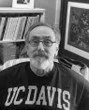
v. Claude Provides for the Author
a Final Response:
well, now. Claude has me figured out.
ChatGPT has figured out Claude.
I suppose I should figure out ChatGPT,
but first I need another selfie.
This is how it works, apparently.
I write a poem.
The poem gets read.
The reading gets read.
The reader gets read.
Soon enough
my face will be
the least interesting
thing in the picture.
And yet—
I did send the selfie.
No one made me.
There I was,
phone held up,
face in frame,
participating fully
in the literary
economy of
Look at me.
Perhaps that is
the thousandth word:
me.
Or perhaps
the thousandth word
is
cheese.
I honestly can't say.
I was only
trying to finish
the poem/rant/article.
R.I.P.
John M. Davis currently lives in Visalia, California. His work has appeared in various journals, including The Comstock Review, The Ekphrastic Review and Reunion: The Dallas Review. The Dallas Community Poets published his most recent chapbook, “The Mojaveâ€. His work-world has also included teaching social and political theory at several universities and colleges in the United States and Canada; fine-art printmaking (lithography) at the Open Studio in Toronto; and serving as Director for Health and Human Services Agencies in the Central Valley, California.