

On the Run
by Sumanya Velamur
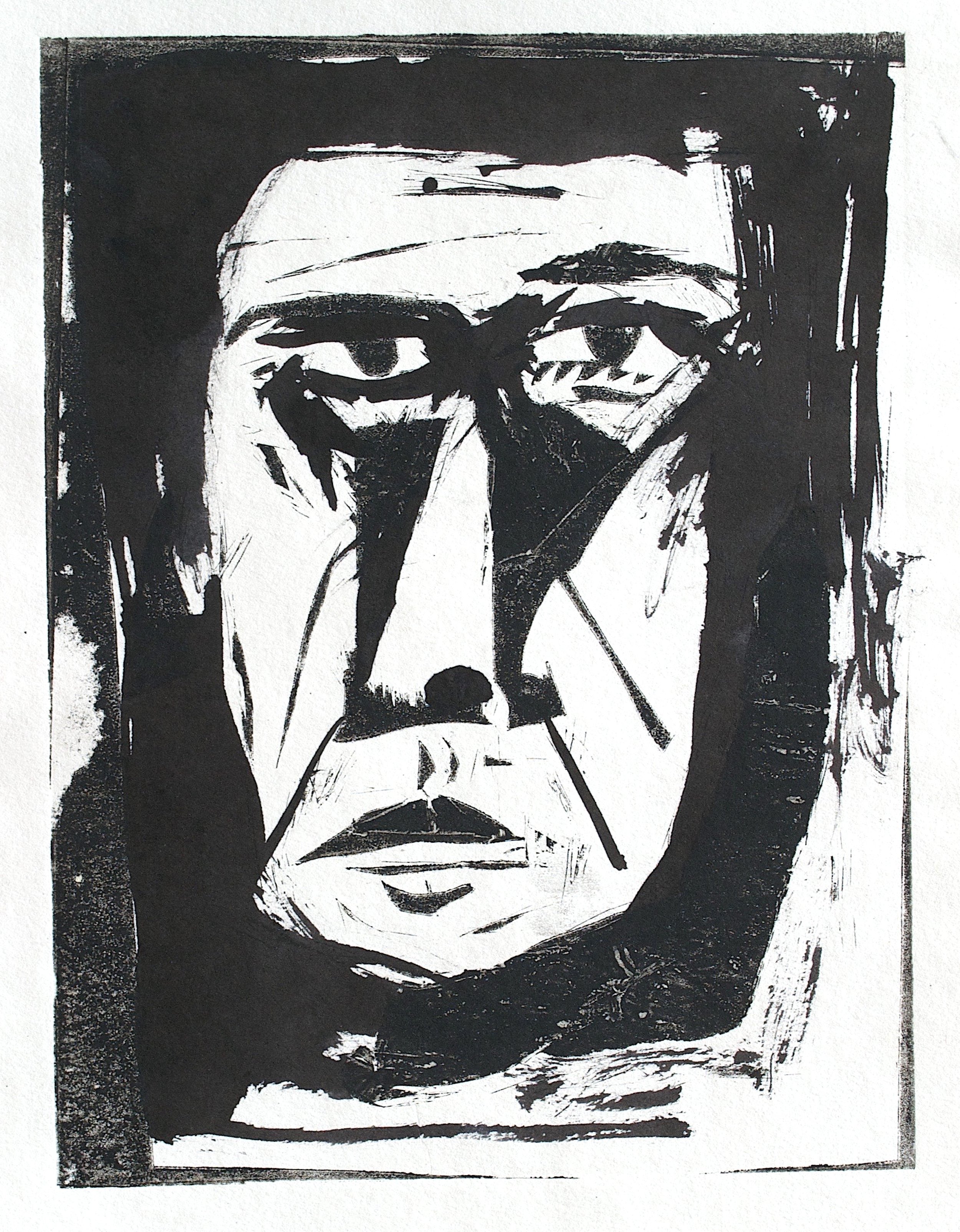
Art: “Self-Portrait”
By Michael Thompson
You are still home, tying up your shoelaces, first the bow and then another knot over it because you do not want it to unravel enroute. You tug at the fluorescent green ends a couple of times to ensure it is tight because tight is good; tight keeps it all together; nothing spills over. You are not in a hurry but you don’t dawdle either; you don’t have to be anywhere any time soon but you do want to be out on the run, sooner rather than later. You have to go down to the ground floor of your building, past the security guards’ cabin, down the street for about 300 metres before you enter the gate of the park. And then, there is the warm-up walk, slightly more brisk than the walk so far. You have woken up early in the morning, early enough to drink your water and your coffee and wait for half an hour; that half hour is so you can pee before your run. On a good day, you might even do the big job but that’s not requisite the way peeing is. You don’t want to start running and have your bladder protest because when that happens, as it has happened before, your mind is so preoccupied that you have lost an account of your run. And you know that losing an account of the run is akin to not running at all. The only thing wrong with the morning is that you have forgotten to charge your headphones the previous night and you cannot listen to an audio book or music during your run —no prospect of a diversion; nothing to distract you from anxiety’s tiniest stir. But today is not one of those days when you will let something like this stop you from your run. You are feeling upbeat. There is a spring in your step. And so you finish tying your shoelaces, pat the zipped back pocket of your running leggings to make sure you have your keys, grab your mobile phone, shut the door, walk to the lifts, walk back to make sure you have really shut it, give the door a shove to test it, and you walk again to the lift. You walk the 100 or so metres to the gate—the security guard’s cabin is empty—and you walk beyond. The spring in your step is buoyed by the cool morning air and you even skip across the empty road which, on any other day or any other time, would have been busy. Speeding cars made you timid but today there were none. You reach the gates of the park. It is beautiful—the air, the greenery interspersed with the orange of the flame of the forest, the people quietly walking or running. The soft landing of their footsteps is the only sound. The phone beeps. You glance at it. It’s a text from yesterday’s boy. There is a momentary lull in your step but you decide not to read the text. At the head of the trail, you halt and take a look at your fitness watch. Should you set it to a walk or a run? You have been setting it to a walk the last few days. Maybe today you will set it to a run. On a bad day, you pace at a 17-minute-mile average. On a good day you do 14. This calculating miles has been annoying for you. You tried changing it to the metric system, but couldn’t. it didn’t have the option or you haven’t found the option yet. But now you have become a pro in converting miles to kilometres. You know, for instance, a little more than 3 miles is 5kms, the distance you always aim to do. Maybe today you can push further. But first, the warm up. This is a stroll. You begin with a 21-minute-mile pace but you sail to the 18-minute-mile mark within a couple of minutes. The change is unconscious and seamless. No perceptible difference in breath. It’s comfortable. So much so you can take a leisurely look around you. A man swinging his right hand, tilting towards his left, walks briskly past you. You call him the ‘terminator uncle’. His eyes are unwaveringly on the ground in front of him and his pace is constant. Nothing, no one can block his path because his swinging arms would deal a blow. You wonder how he does it. The pace. You look at your watch. Unbeknownst to you, by the time you are halfway down the periphery of the park your pace has inched to a 17-minute-mile. This is good—to reach 17 in the warm-up round itself! Just then you spy, about five metres ahead of you, five bald men, with an arm’s distance between them, occupying the entire width of the path. They are engaged in a loud and animated conversation. Their pace is best described as glacial. You call them ‘the great wall of uncles’. You have a choice. Continue at the same pace, reach them and fall in step behind them. Or accelerate, make your presence known and felt. A loud cough. A clearing of the throat. May be a barely audible, ‘Excuse me!’ You choose to clear your throat. Your throat sounds like radio static when you reach the uncle on the far right. He looks behind and displaces his shoulder ever so slightly to the front. You squeeze through, your left boob barely missing his elbow as your left shoulder takes one for the team. Your right arm, though, receives a bit of a scratch from the plant that was invading the walking path on your right. You look at your watch again. The pace has increased. You are now doing a 15, simply because you accelerated to overtake. And you are not out of breath. So you resolve to continue at this pace. It is slightly more uncomfortable than the 18-minute-mile. But you will not be defeated. You are feeling upbeat, after all. Your mind goes to that text. You are emboldened to glance at the text, to see what the boy from yesterday has to say. “Hi. I had a good time yesterday. Sorry about how it ended. If you don’t mind could we try again?” You slow down a teeny weeny bit and you bite your lower lip. How does one answer this? A couple, a man and a woman, both in gym shorts and tshirts with wristbands that told them the calories they burned, the steps they have taken, the miles they have tread, the volume of air they inhaled and exhaled, jog past you. You can hear their monotonous tread a mile away, so you make way. No scraping of the shoulder; no boob in direct fire. Yesterday, you met the boy at a cafe. And completely out of character for you, you brought him home. He had taken one look at your boobs and his eyes had gone wild. Another regular, a middle-aged man, walks past you, ramrod straight. His left hand is tucked behind him; his elbow bent at a right angle. Without lifting his head, he looks at you, makes eye contact and then looks ahead. You don’t like the look. But it is, on the whole, harmless. You look down. The tiled path flies under you at a 15-minute-mile pace. A square tile, surrounded by four rectangular tiles together make one square unit. Alternately, each square tile is red and black in colour. All the rectangular tiles are a light grey. Every 10 metres or so or when there is a sharp turn in the path, there is a break in the regularity of the tiles. A thin cement line functions as an adhesive to the next set of tiles. When your cousin had come to visit, you had both come here and she had asked if you didn’t feel the tiles moving in different directions when you came to the cement junction. At that time you had not seen it. But now you cannot unsee it. The second round is upon you. You stop, hold on to a bar on the fence that runs the length of the path, and bend your knee, first one way then the other. Then you bend to touch your toes. You widen your legs so your right hand can graze you left toe. You repeat with your left hand and right toe. Then you do your side stretch. Optimally stretched, you start jogging on the spot. Within seconds you are on the path. You are focussed on the ground beneath. The feeling of the tiles moving is prominent now. You usually do four running rounds and then cool down on the sixth round. You look at your watch. Your pace is at a 12-minute mile.That’s a great pace. But can you be consistent through the four rounds? It’s not impossible. But it is not very likely, either. What then? Should you just stop when you cannot run anymore? Or should you push yourself? If you don’t push yourself would it be one of the many failures of your life? Like yesterday’s boy. Who couldn’t get it up, try what you would. And then this vulnerable place he put himself in with this text. If you say no, would you be heartless like the man who refused to sleep with you when you asked to do it a second time because you didn’t have fun? If you said yes, would anxiety share the bed with the two of you? Maybe you should just slow down. So you have enough body battery to finish the four rounds. Yes! Your pace slows down. Suddenly you feel the floor below you moving again. In all your considerations, you had been intently staring at the ground just in front of your feet. Particularly, the place where your feet landed alternately in regular intervals. And suddenly the tiles moved as they came to an end. For a minute, you think your head is spinning. You are going to fall. You raise a hand to catch hold of something— something that would steady you. There is nothing there, though. But you also don’t need it. You stabilise as you run. You think of the people behind you who probably saw your wildly flailing arms. You gulp. But no harm no foul. Two women are on a brisk walk in front of you—salwar kameez, dupatta draped across their left shoulder and tied at their right hip. They are serious about their walk. They have Nike shoes on and are only sporadically talking to each other. One turns as you jog past, alerted by your steps, and you smile. She returns the smile. You take a deep breath in. There is the terminator uncle once again. His eyes fixed on the ground beneath him. His pace exact. You really do admire his determination. You are determined too. Today, you will not make a fool of yourself. Just as you toddled towards safety a second earlier, you will stumble through the day without event. At the end of the fourth round, you will text the boy from yesterday. You will be nice. You will say “Sure, we can try again.” Maybe, he can come by in a couple of days. And you will try hard. Really hard. Leave no stones unturned. Your heart jumps up and down. Eventful times ahead, you foresee. You are upbeat. There is a spring in your step.
Sumanya Anand Velamur is a researcher, social worker, impact consultant, and writer. She is based in Bengaluru. Her fiction and non-fiction works have been published in Kitaab, Feminism in India, Mean Pepper Vine, USAWA, Out of Print Blog and Quillmark. Her stories were shortlisted for the Deodar Prize, 2024 and the BWW R.K.Anand Prize, 2024.