

Nurse, In Deed
by William Swanger
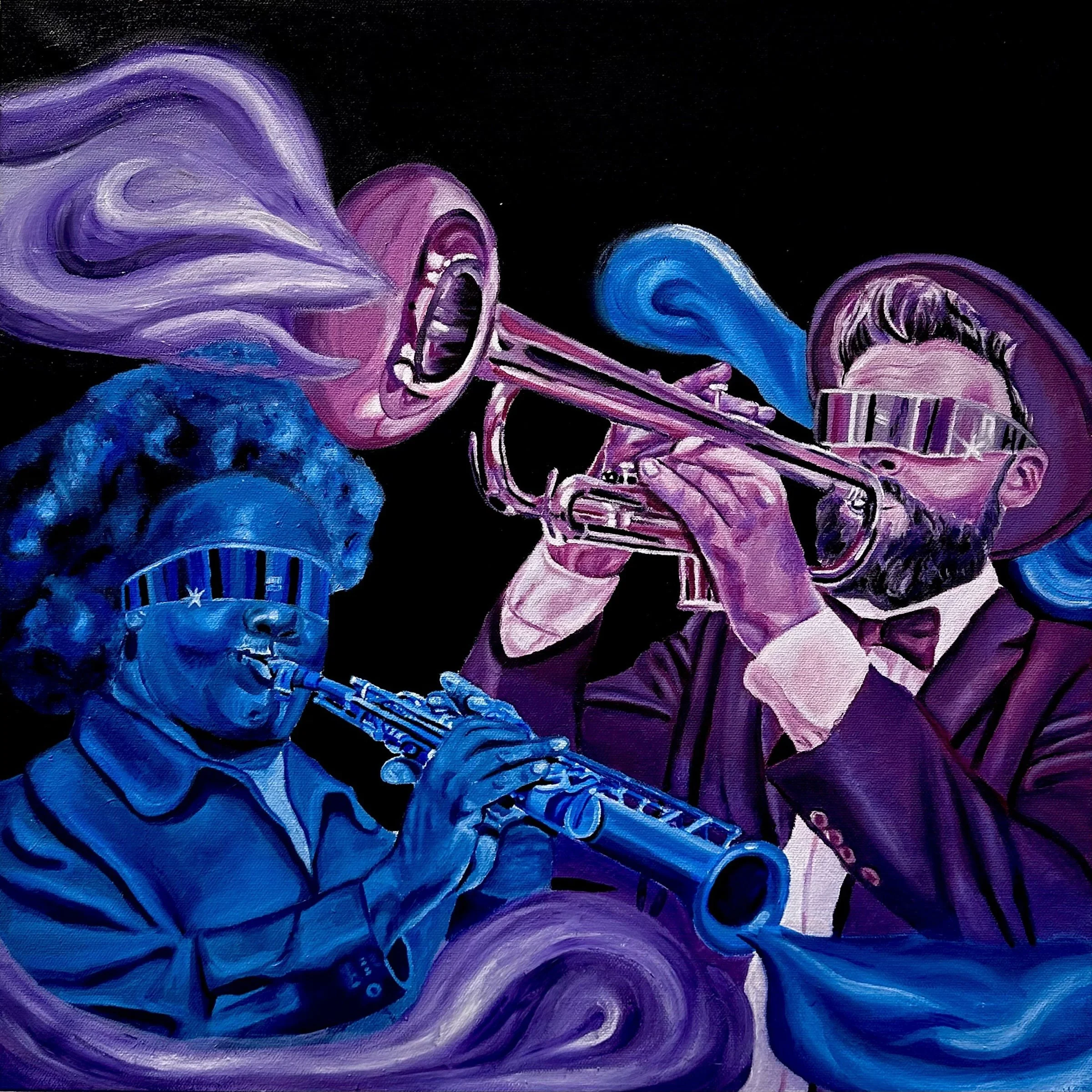
Art: “Remember the Future”
By Amur Morris
I drove my father’s ’52 Dodge onto the hill, ignoring the pickup’s raucous, exhaust-filled distaste for the incline. I edged it close enough to the field to nuzzle the rows of corn stalks that spilled off the knoll, flooding the valley below.
The sea of corn was heartening. I had to pick a gross and I was on my own. I had already paid the two Old Order Mennonite teens, only a year or two my junior, who stood in a roadside shack exchanging money for used grocery bags and freedom to harvest their family’s fields. I could have picked twenty-four dozen ears and they’d have never known, but their solemnity ensured honesty. How could you take advantage of young people dressed in long clothing and consigned to the dusty road in this heat, the boy’s beard just beginning to sprout, the girl’s uncut locks peeking mysteriously from beneath a small bonnet?
I plunged into the uppermost rows and began plucking ears from tall stalks that danced away from me in the bright sky as if trying to flee my clutch. Cautious of stowaway pests, I stripped down silk in search of earworms, tossing infested ears headlong into the neighboring row. By the end of two hours, I had thrown thirteen bags into the rusty pickup bed, having tried to jam a dozen ears into each paper sack but failing, the final tote hosting the residue.
I was relieved to be done. Twice I had become lost in the maze of rows, as if Halloween were springing itself on me months early, an alarming claustrophobia descending until I was able to spot the pickup’s ugly-green shimmer through gaps in the closing-in stalks.
Dripping with sweat and itchy from the embrace of sharp leaves, I hoisted myself into the truck cab and drove down the hill. As I turned onto the country lane leading to my family’s summer cottage, I glanced at the bonneted girl, imagining for a moment her hair flowing free. The image clung to me as I drove beside the glistening creek that eventually rear-ended our cottage. I dawdled at the prospect of husking so much corn, yet I knew my mother waited alone, so I gave the gas pedal a shove. The truck bucked but sped up, as if comprehending the task ahead, relished but also dreaded.
I hauled the corn inside our cottage and with my father at work in our pharmacy six miles away, my mother and I began the task of husking all that corn. Blanching the ears eight or nine at a time, we wielded our knives against each cob, kernels cascading into bowls in chunks, bound by their own starch. Occasionally we would nab one of the slabs, lard butter on it, pop it into our mouths and smile. By afternoon’s end, we were exhausted. We had filled too many containers to count, readying them for our freezer back home.
The table and floor were spattered with corn that resisted clean-up. I scooted under the table with dish rag, deploying fingernails to coax recalcitrant kernels. My mother smiled at me for helping to clean up. I basked in her approval but was just as motivated to ease her cares because, from experience, I knew the day’s toil would wear on her, that she would soon be resting in her recliner, staring silently into the past, the malady that had extinguished her most precious dream having insisted on playing its recurrent role in her life, relentlessly siphoning her energy a drop at a time.
* * *
Although the Great Depression overshadowed much of my mother’s youth, it never dulled her resolve. By her eighteenth birthday, she had squirreled away $35—one year’s tuition for nursing school, a near-fortune to her though considered a nominal fee in light of the hospital apprenticeship work she and her classmates would do during their training—and was well on her way to amassing double that amount for the remaining two years of training. She thrilled to think of the career ahead. Long hospital shifts didn’t worry her, nor did the fact rules prevented her from marrying while in training.
She had already bested more odds than most people, including poverty and a home life darkened by an alcoholic steelworker father, who swore at her and her four sisters, but occasionally beat her brothers. At 14, she sought temporary refuge at the local amusement park, where she earned her nursing-school tuition and whose owners eventually paid to have her rotted teeth pulled. Diligently achieving grades necessary for nursing school, she easily checked off other training stipulations: She overflowed with good character and she was of sound health, a final checkmark that stood strong nearly to the day of nursing school admission, when rheumatic fever struck.
A disease of the era, the illness quickly confined her to bed, days merging into weeks as she battled exhaustion and, eventually, a shadowy drain on her psyche. Barely out of her teens, she struggled mightily to get well, which she eventually did physically, yet uncharacteristically stumbled in facing a new foe, a bereavement of direction. Her twin sister tended to her, ultimately nursing my mother fully back to health but never to nursing itself, a career path meant to heal disease but not itself a victim of disease.
Her chosen path walled off by illness and arbitrary rules, my mother found the loss of her dream nestling in as unwelcome companion, forcing her to grapple with periodic downheartedness over the demise of her longed-for chance at beneficence.
Yet she craved impact. She built a business and, later, another. She managed family life and helped in the pharmacy. She chaired community committees, oversaw volunteers and organized events. On a few occasions she cared for her siblings, relishing the opportunity to heal. Like a professional, she also nursed me through childhood illnesses, proffering attentive care.
Yet my mother could not always subdue the persistent thoughts of a life lost that poked about her subconscious. My father and I tried to tame this occasional specter, just as this day I offered helpfulness and strained attempts at joviality as counterpunch offensive.
We became like glimpses of that green truck through wavering maize rows, guides for the way forward, pointing out all she had achieved. Typically we were enough, but occasionally the haunting reminders would not be put down, the view that, from her perspective, she’d never quite navigated the very different maze life had tossed her into.
* * *
Rheumatic fever’s final strike came decades later, while I was coaching my daughter’s softball game. By then nearly 80, my mother had fallen victim to a second stroke, her malady’s occasional denouement.
I made it to her side in the emergency room even before my father, who had tried but failed to tail the speeding ambulance from their home. The stroke was devastating.
As I spoke, she seemed to try to turn her stiffened form toward me, a single tear escaping her staring eyes.
I like to believe that tear came because she was looking toward her son for the last time.
But I understand as well that it rolled silently down her cheek because somewhere behind the curtains her stroke was pulling closed, my mother wished fervently, if for just one moment, to be standing next to her own ER stretcher, offering that dying, elderly patient the care she had always felt destined to give.
William Swanger is an adjunct faculty member at two universities. He writes fiction and creative nonfiction and has been published by The Genre Society, Academy of the Heart and Mind, and a university-based literary journal. He was twice invited to pitch stories to television production companies based on his speculative scripts, experiences outlined on his website, www.williamswangerwriter.com.