

Kembali
by Audilia K
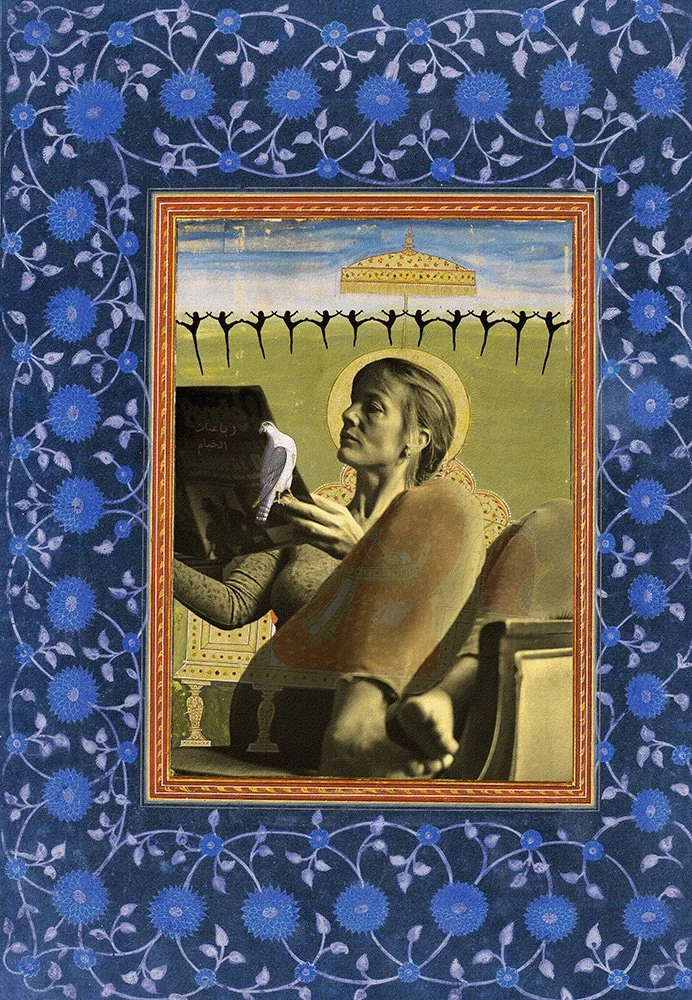
Art: “"Portrait with a Bird"
By Najib Joe Hakim
Kembali
In Javanese culture, to return often harkens back to your family: to be a good daughter, to take care of your parents, to give back—and most importantly, kembali ke rumah (to come home). This collection details the journey behind trying to mend a relationship between a mother and
daughter, and how the road home is filled with unanswered questions and realizations.
I. Reflections
My mother is wounded. {Her scars have never healed all the way through, possessing he pale skin like a faint bruise. She picks at old wounds, scabs forming and cells scrambling to re-achieve equilibrium, only for another round of tension, snap, and pull.}
My mother is a little girl. {She is stuborn, as they all are, and she is prideful in a way my grandparents have taught. She leans on others without knowing pillars can still falter; she trusts too easily—just look at my father and the one she wished was hers by the eyes of our founding fathers. She is naivety concealed by bravado.}
My mother is oblivious. {I tell her the axe forgets, but the tree remembers, and she says she’s never said the words I accused her of. She acts like I’m conjuring imaginary scenes, that those words are foreign to her tongue. My anger comes to a simmer when she confesses that my grandmother—who was, in many ways, my savior and picture of kindness—gave her the cold shoulder and handed her a crash course in the art of repression.}
My mother is cold. {Confusion paints itself on her face when she talks about self-expression. She doesn’t know how to say she cares, doesn’t know how to love in the way her children need her to. How she birthed me is proof that we are more than our genetic codes, for I am soft and loud and I bleed in prose. Perhaps, this fundamental diffeence is why we can never strike a balance, and why we stumble whenever we’re near one another.}
In a coffee shop, tears are slipping down my cheeks because my mother says the words I wish I would’ve heard when I was younger. It tempers something within me: I realize I can be angry at how she treated me, yet still be gentle in my tone.
She has bent and grown, but selfishly, I don’t know if that can be enough for me. I don’t know if she’ll ever see me, truly, rather than a replica of who she wanted herself to be.
II. Contradictions
“Slipping Through My Fingers” is playing on my speaker, and I feel an aching sadness for my mother.
Does complicated begin to describe the relationship between a girl and her mother? Almost as if it was god-given, predetermined fate, each path seems to be rife with misunderstandings and toppling with bubbling emotions.
I love my mother. I don’t want to tell her anything. I crave my mother’s comfort. I hate being vulnerable around her. I want her to be happy. I want to stay countries and oceans away from her. I wish she understood me. I leave no room for her to see me.
Existing on a paradoxical and self-contradictory axis, I don’t know what to make of my mother.
She is my mother—but she is also a woman. One hurt by her past flames, one who has her own share of emotional baggage, one who makes mistakes, and one who dreams and dreams yet surrenders still in favor of giving and giving. She is abundant—yet she is a drying well.
What do I make of someone who hurt me without knowing, whose decisions and inaction left imprints on my psyche, who’s flawed but trying—but loves the only way she knows how? Half-full, far away, and hidden in signs.
Whenever I wish for a mother that understood me, did she think the same of the daughter that inched away more and more each day?
What a delicate balance, a prickly push and pull.
III. Tightrope
I bought my mom a plane ticket to Hong Kong.
Singapore Airlines. CGK to HKG. Round-trip. Economy.
There is a certain pride attached to this. Despite the ups and the
down
down
downs
she is still my mother. And I still want to give back.
(I can feel past ghosts humming, nodding approvals; what a good daughter)
As much as the bonds of family chafe, as much as my thoughts on them remain in a curious state, she is still my mother and they are still my blood—
{Javanese families live and breathe that saying. There is no higher disrespect than the unceremonious slashing of ties, but white lies seem to be rife. We do not communicate with truth—we speak in riddles and insincere eyes.}
Three years in therapy and I still don’t know what to make of my childhood city. I’m not as fearful—thankfully—but I’m no longer meek; instead, I speak
(and I invite them to disagree)
and I visit on my terms. I am independent in the way they hate, filled with antithetical ideals that misalign with what our culture says. They say I’ve grown unruly living here, on my own.
Despite that, I breathe a sigh of relief.
(There is a sense of safety in knowing that I have control. Try as they might, I think they’re starting to realize I've grown—and I don’t need their mercy or to atone)
I suppose the difference between now and before is that I can finally set the tone. I suppose that’s a step further into mending these prickly thorns that proliferate back home.
A writer since her formative years, Audilia is a strong believer in universal narratives. In her university years, she integrated psychology and literature to further underline her belief in how humans are made up of stories. Her favorite forms of self-expression are her writings and her tattoos, finding them as powerful mediums in telling her story of self. Through her work, she hopes to give her readers the same kind of catharsis and solace she finds in writing her own.