

Finding Frankenstein’s Monkey in Costa Rica
by Bliss Goldstein
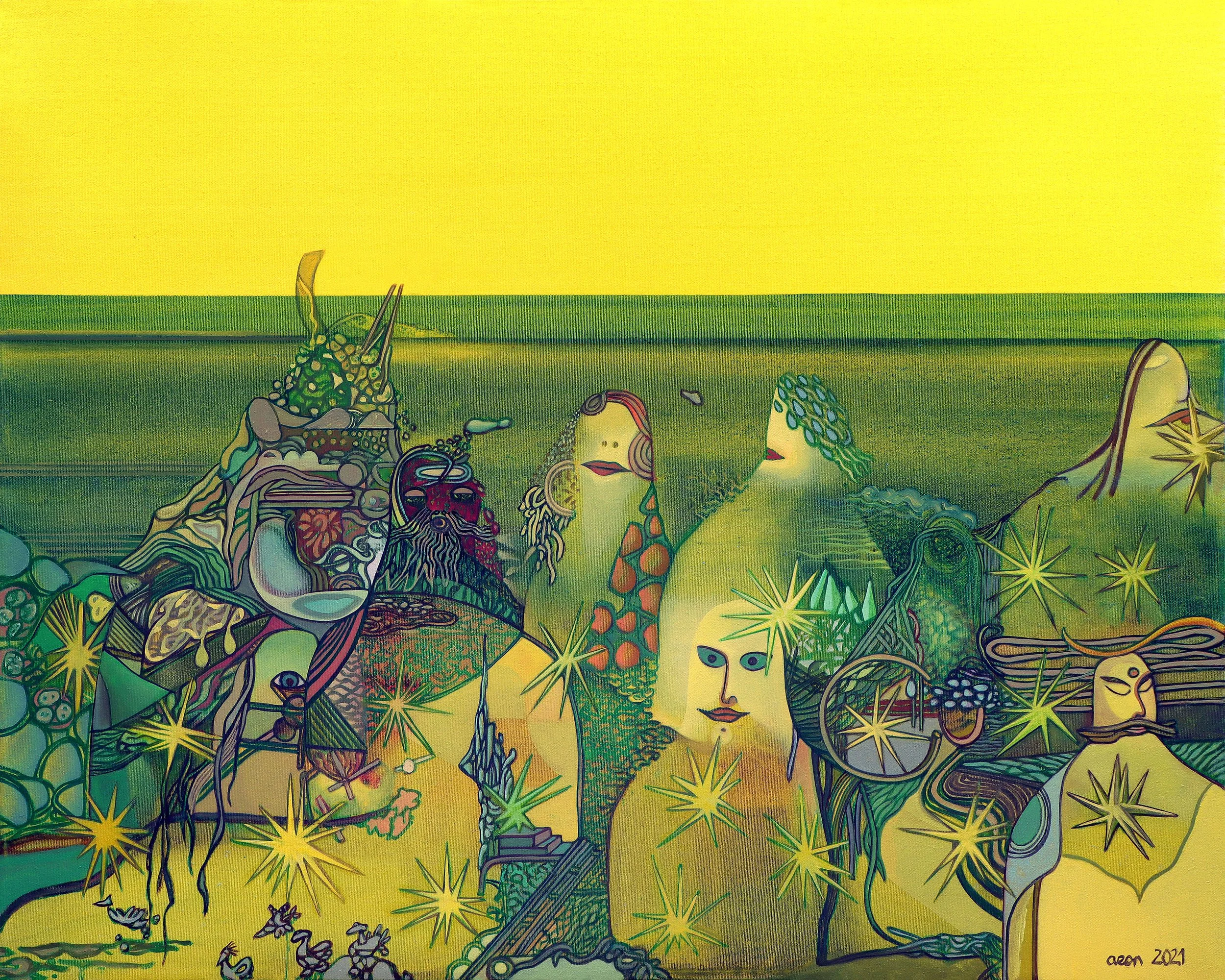
Art: “Bathers”
By Alexey Adonin
On the veranda of our eco-friendly lodge in the mountains of Costa Rica, I waited for my sleeping husband to join me for breakfast. A purple orchid, the national flower of Costa Rica, rested atop my bamboo napkin. I inhaled the orchid’s honey scent, then reached for my first cup of coffee. Costa Rican coffee had turned out to be bitter with notes of acidity and weltschmertz. I needed coffee to be awake. But awake to what? During the last few years, the world had left me with a bitter taste in my mouth, as if bitterness had become my beverage of choice. A high-pitched squeak interrupted my first sip.
Beyond the railing, on a small metal platform, a capuchin monkey frenetically grabbed bananas from a lodge-provided feast. Another monkey dared to swing from branches towards the bounty and had been met with a warrior cry. I watched as the intruding monkey pivoted as quickly as our U.S. democracy had and scampered away.
A hairy white face with rubbery pale-pink lips turned towards me with a scowl. He’d made a basket of his hands in which half-eaten bananas crowded each other. The thug monkey started shoving bananas into his mouth, chunks spraying, while other hairy monkey faces peeked out from behind large leaves.
I wanted to shout: “Stop! You have more than enough. Leave some for the little guys.”
The thug monkey met my stare with dead eyes. I heard the crunch of decency crumbling behind rubbery lips. I was the first one to look away, too tired to play a staring game with a primate. All the marching and voting and letter writing back home had worn me out. I needed this vacation.
My husband, Dan, and I had started our journey at the Blue Spirit Retreat Center on the west coast of Costa Rica. The shower terrified me—where there should have been a fourth wall there was only air. If soap got in my eyes, I might tumble naked over the edge into the infinite jungle below. High-pitched whines of insects mating and dying filled the room. The guttural hoots of roving howler monkeys added to the cacophony.
Scanning the jungle, I was relieved no red eyes stared through the foliage ready to pounce or slither my way. I reached for the shower knob to twist on the water. My fingers came within a millimeter of knuckling a fat lump. An unmoving yellow toad suctioned to the tile wall.
I did what any self-congratulating feminist would do: I screamed for my husband.
Dan assessed the crisis and eased a piece of paper between the toad and the wall. He deposited the creature onto a banana leaf hanging within reach. We watched as the toad scaled the tree, as if he had all the time in the world, and then vanish.
Later I googled until I found a photo of the yellow amphibian. Golden Toads were the first species to fall to climate change, the canary-in-the-coalmine in the jungles of Costa Rica. The Golden Toad was last seen in 1989.
Damn. I wished I’d snagged a photo. If I had that proof-of-life, I could’ve sold it to National Geographic and donated ten percent—nay, fifteen percent—of the proceeds to saving the planet from global warming.
I patted myself on the back. I was a freaking Greta Thunberg.
Dan and I left the humidity at the beach for the mountains. Fifty years ago, eleven percent of the planet was cloud forest. Now only one percent. Our private driver wound his town car up a potholed road along the edge of a cliff, pointing out the sights and describing them in halting English. The blue of the Pacific shrank into the distance. By the time we stopped at a roadside café for lunch, I was famished. I invited our driver to join us, but he demurred.
“Pura Vida,” he said. In this context, I knew Pura Vida meant, “Thank you, but no thank you. Please enjoy your gallo pinto.”
“Pura Vida,” I replied, hoping I was pronouncing it right.
Our driver held up his phone and a woman translated in a British accent. “In Costa Rica we respect all creatures and strive to live in harmony. Pura Vida.”
“Pura Vida,” he exclaimed.
I was getting used to the omnipresent call and response of Pura Vida. Those two simple words wrapped together hello, goodbye, thank you, and peace be with you. Costa Ricans reminded each other of what was important by sing-songing it in most interactions.
Our driver signaled time to leave. He dropped us at our next lodge waving goodbye with a warm Pura Vida. While Dan checked us into our room, I wandered the outdoor lobby, pausing to drink in the Aranel Volcano in the distance. Its cone rose through a deep mist. Hibiscus perfumed the air. Something wispy brushed my bare calves. I jumped. A peacock with a shimmering crown of blue-green feathers swished its train as it strolled past.
The giant bird hopped onto a table in front of a gilded mirror and cocked its iridescent head while gazing at its reflection. Did it see another peacock or itself? Slowly, the bird fanned its tail feathers, revealing a multitude of chartreuse-ringed eyes.
I marveled at the sight, until another vision rose before me: My dining room table, which I’d adorned with a crystal vase full of peacock feathers. It never occurred to me that a sentient being had once been attached.
The peacock shrieked—shrill and ugly. What had it seen in the mirror?
Our last night in Costa Rica arrived, and with it, what I’d been waiting for: The Night Frog Tour. The brochure cover featured a green frog with splayed toes and bulging red eyes. I had to see this magical creature before we left. Our newest van driver chatted with us in fluent English.
“I love frogs,” I said as the van sped through the dark, “but I hate snakes and spiders.”
Dan, an intense lover of all reptiles and insects piped up, “Not me.” When he was young, he used to wander the desert to capture kingsnakes.
“Plenty of snakes and spiders,” the guide said. He sounded cheerful, like he couldn’t think of anything more delightful. Next to me, I felt my husband swoon.
“No, I’m not kidding. I hate snakes and spiders,” I said.
The guide reassured me we’d see plenty of each.
After a bumpy ride, the guide swerved off road into a jungle so dense the night became inky. When he parked and slid the van door open, the heavy air smacked me in the face. The guide handed us flashlights. I tried to keep up with my normally slow-moving husband while my flashlight illuminated trees hung with hundreds of webs.
“Look,” Dan said, motioning me closer to a tree trunk.
A little green frog with fire-red eyes clung onto a branch. The frog’s skin fluttered with its breathing. If I could have smuggled the little creature onto the plane in a shoe, I would have. As if weary of being admired, the frog dropped off the branch and out of our sight. I sent a prayer for its safe journey avoiding wasps, spider webs, and possible kidnaping by tourists.
“In 1996, the Forest Law was passed,” our guide said, interrupting my devotions. He swept his flashlight in giant circles around the trees and over the dirt path. “We are reversing deforestation.” The guide had every right to sound proud.
A few minutes later, I almost bumped into our guide. With the tip of his shoe, the guide carefully lifted a pile of dead leaves Dan had nearly stepped on as he took the lead. Underneath the decaying pile was the fattest, ugliest motherfucker of a snake I’d ever seen. Swatches of dirt covered most of his body.
In a reverent tone our guide said, “This is the Fer-de-lance, the deadliest snake in Costa Rica.” Dan bent down to take a closer look.
The night spun around me and I heaved, “Oh, no, oh, no, oh no.”
As the guide’s arm wrapped around my waist, he caught me mid-faint. Back in the van—where he and Dan dragged me on collapsing legs—I pressed my clammy head against the window. I watched as the jungle sped by, still feeling vertigo at my husband’s near-death experience. I was ready to go home to another species of snakes.
Back in the U.S., after four airports, three time zones, and a man braying to his travel companion, “Costa Rica abolished their army and the drug cartels pour in? They should build a wall,” we finally landed at SEATAC. Without even a “sorry,” a young guy wearing square black glasses that screamed techie pushed by me on the concourse. His expensive-looking backpack smacked my shoulder. I teetered, bleary-eyed, next to Dan as he searched an electronic board for our final connection. Rain hit the windows overlooking the tarmac. I shivered to think of the slog through the cold downpour to a smaller plane.
Through the crush of humanity inside this neon jungle, I spied an old-fashioned gumball machine outside a candy shoppe. Its glass orb reminded me of an antique diver’s helmet. Inside, mounded a sea of neon-colored gumballs. I left Dan’s side and twisted the chunky handle. A metallic clank rewarded my effort. When I lifted the hatch, a yellow gumball rolled into my waiting hand.
Was I supposed to pay for this? Through the shop window, the sales clerk glared at a group of teens pushing in front of open bins and not me.
I popped the gumball into my mouth. The yellow shell cracked between my molars releasing banana. My eyes slitted with pleasure. Banana-flavored were my favorite. I twisted the handle again. And again. I picked up speed—grabbing as if in a trance, not caring what color they were—and shoved three more gumballs into my mouth.
Dan appeared next to me.
“Gate 3-C,” he said. “I’ll meet you there. And, by the way, the white ones are the best.”
Of course, my husband would want the rarest gumball, so few whites in a sea of color.
With no time to waste, I nudged off the tin disk at the top of the gumball machine and lowered my hand for buried treasure. My fingers closed around a white gumball.
On a TV meant to soothe exhausted travelers, a nature show sparked suddenly to life. A toucan filled the screen. My paw froze mid-plunder. On one hand, I venerated Costa Rica—with its Pura Vida ethos and legally protected jungles and wildlife—and with the other hand, I stuffed pilfered gumballs into my mouth like an out-of-control primate taking more than I needed.
But I didn’t want to be Frankenstein’s monkey, a cobbled together creature of greed and good intentions; tsking as the bad monkeys peed from the sky while feeling good about myself because I marched and voted umbrellas for all. Playing the part of Good Liberal wasn’t enough to garner applause. True Pura Vida was quieter and began from within before radiating out.
The gum soured in my mouth.
I caught sight of myself in the airport’s wall of windows. My face flushed from the excitement of gaming the system for sweets. I met my own glazed eyes. It was not a good look.
I heard the shrill cry of the peacock who has just seen herself in the mirror.
A little girl shyly watched me as her parents argued over who had the passports. Her eyes tracked the gumball in my hand. I spat my half-chewed gum into a trash can, then clicked the tin disk back on top of the gumball machine.
“Excuse me,” I said to the squabbling parents. I held up the white gumball, which I’d wrapped in a clean tissue.
“Is it okay if I give this to your daughter?” I said, “I have enough.”
Bliss Goldstein’s been published in HuffPost, LA Times, and CALYX Journal, winning their Margarita Donnelly Prize for Prose Writing. Bliss taught writing at Western Washington University and has an MLA from Stanford University, where she was a previous editor of the journal Tangents. If she's not working on her novel drawn from real life “Cult Momma,” she's most likely hiking in the Pacific Northwest woods among owls, raindrops, and fluorescent fungi. Find more bliss at blissgoldstein.com.