

Ekphrastics
-
![]()
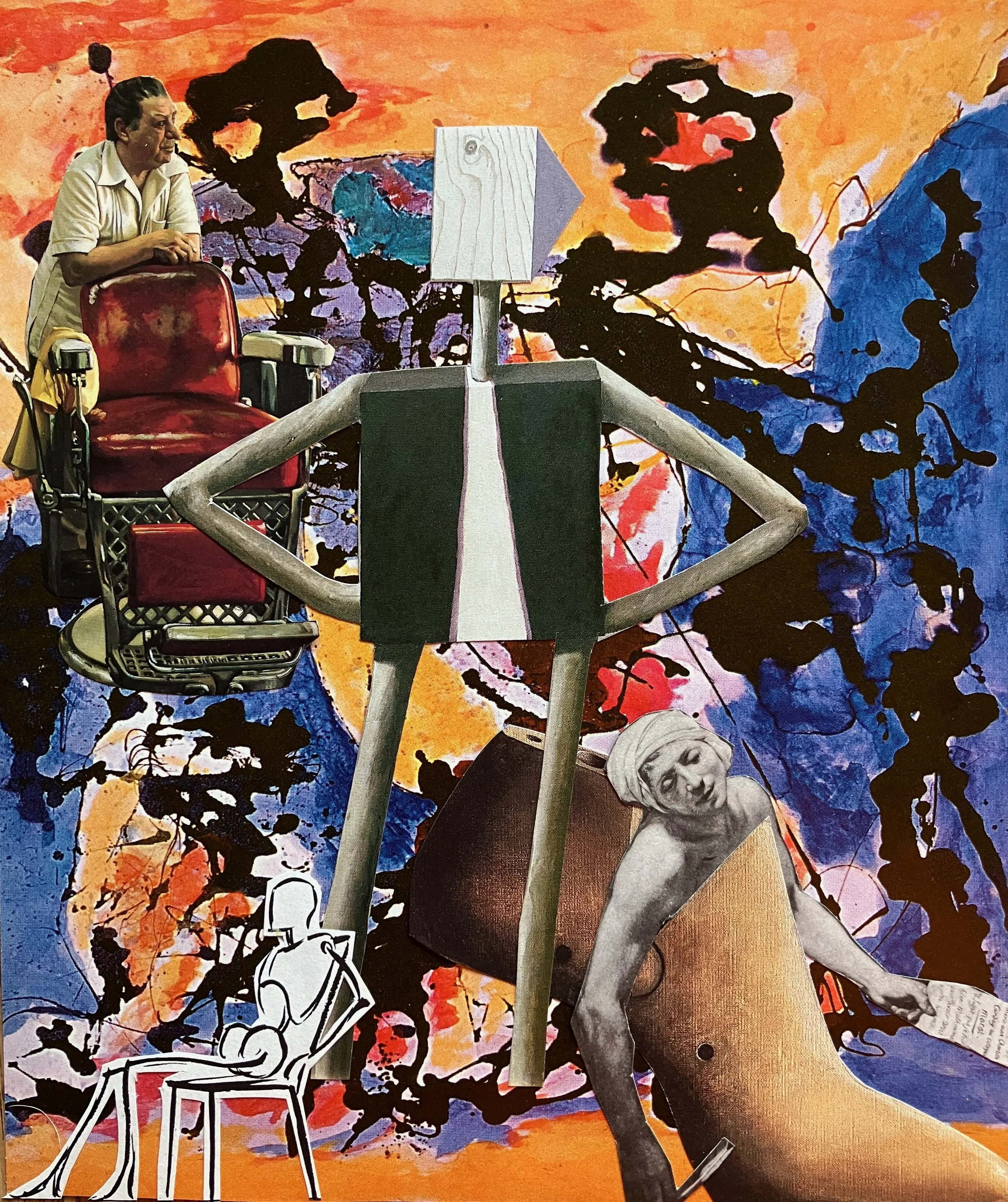
"Shave And A Haircut" - Devon Balwit
-
![]()
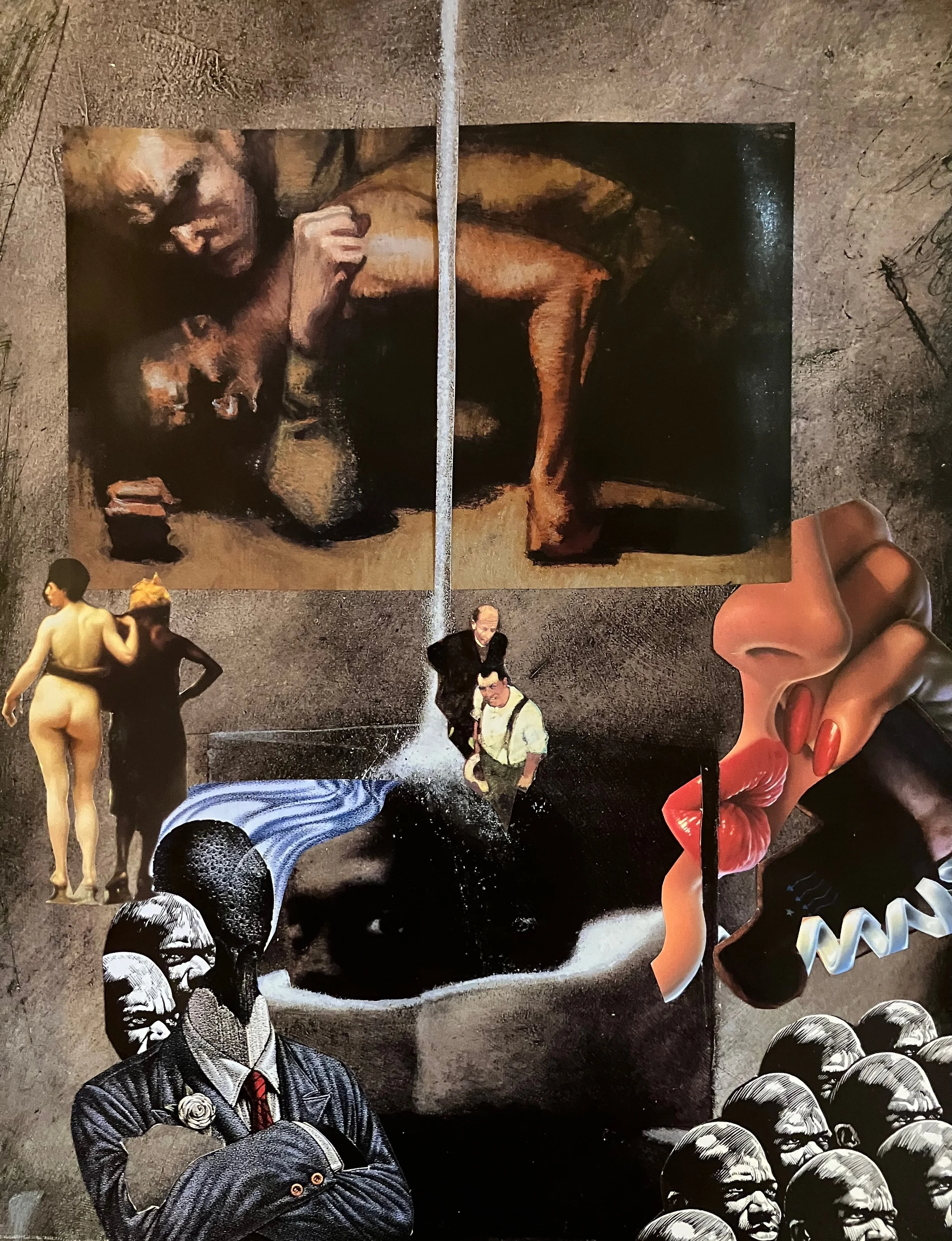
"Smoking” - Devon Balwit
-
![]()
"Shave and a Haircut" - Devon Balwit
-
![]()
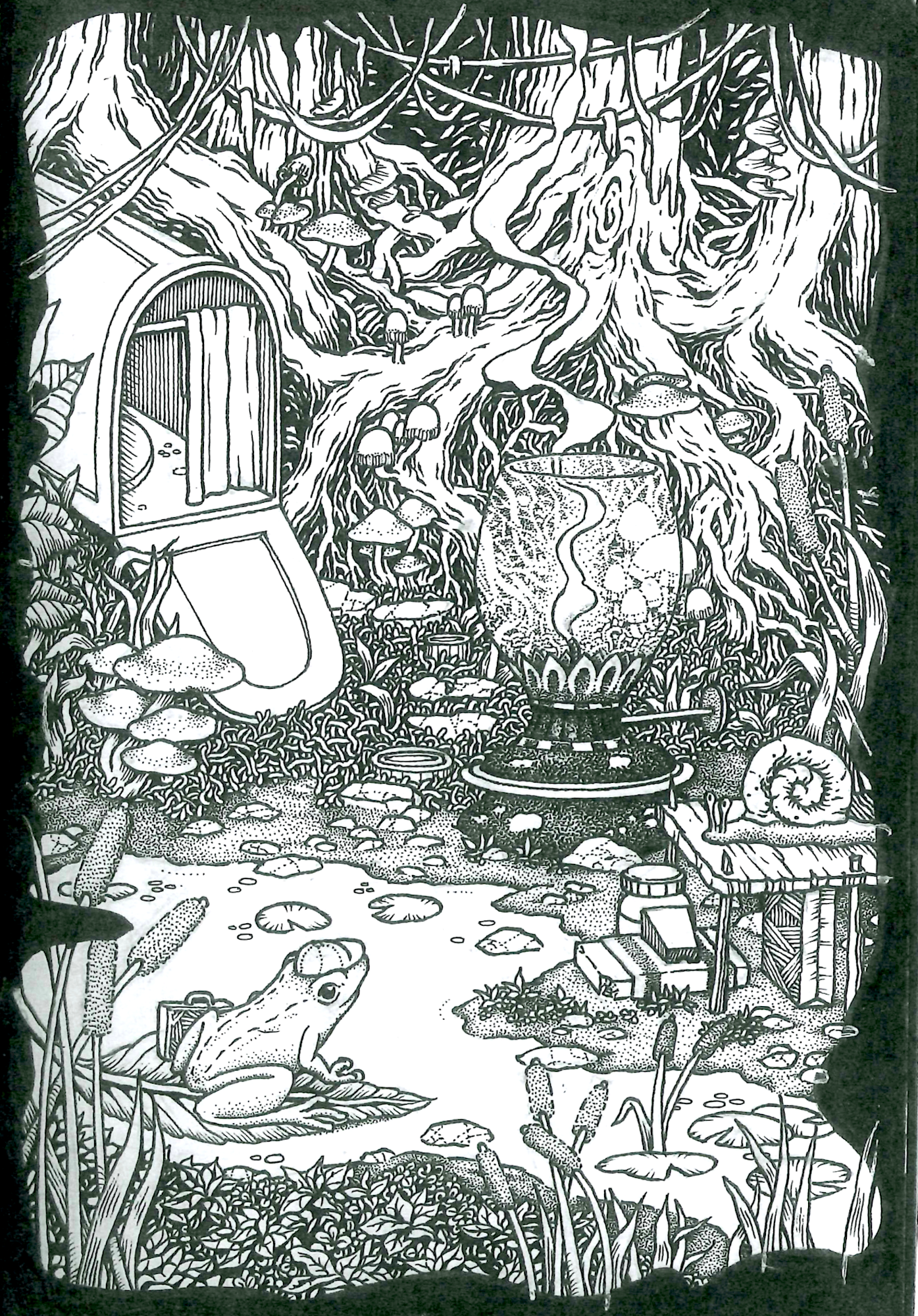
"The Frog's Return" - Sophia Kurtz
Interview with Devon Balwit — (PEOPLE, Vol. VII)
Interview with Devon
1. Can you tell us what first drew you to collage as a medium? Was there a moment—or a body of work—that made it feel like the right language for you?
I had spent the past two years immersed in life-drawing—taking classes and drawing from nude models studios, but I was getting bored with the process. At the end of the day, I just had more or less accurate nudes in a suite of ever-more-familiar poses.
I journal, and one day in a little free library, I found a book with various suggestions about how to enliven a journal, one of which was to create panels with windows which allow you to look from one page through to another. This led me to collage, as I would create two thematically-linked pages, the top one with peepholes into the bottom.
From there, I moved to single-page collages of all sizes.
2. When you begin a piece like Shave and a Haircut or Smoking, what tends to come first: an idea, a specific image, or the act of looking through source material?
I look through source material—boxes of loose images or piles of art books. Usually, images quickly start calling out to one another: thematically, positionally, or in terms of color. Sometimes, the echo is uncomplicated and, at others, ironic.
3. Where does your source material usually come from, and how intentional are you about the age, origin, or cultural moment of the images you use?
I am lucky to live in a house with thousands of books as my husband is a book dealer / collector. I also live in a town that has many book boxes—I too have one—which offer source material as does our local fund-raising bookshop for the library system.
I can tell you, though, it stops the heart, the first time you intentionally slice into a book—every first cut actually. It feels like violence or vandalism. I have to remind myself that it is a stage in the process out of which another form of art will emerge.
I do feel ambivalence about cannibalizing source material in the sense that I’m aware that I incorporate other people’s work into my collages—yet, so many images go into each collage, and the process of making them is so all-consuming, that I don’t take the time to note and reference each one. I have come to a determination that this is not plagiarism or copyright infringement as my collages are one-offs. I am not creating posters, t-shirts, or objects for multiple sale.
4. Do you think of your work as engaging in dialogue with the past—especially given the historical nature of many collage materials—or as something more present-focused?
I am absolutely in dialogue with the past. Many of my works are ironic revisioning of tropes—whether sexual, religious, racial, etc. (You can see this in “Smoking,” which clearly interrogates both race / gender.) Some of my collages involve literal interweaving of old and new pieces. I do the same with my poetry—one of my collections is my take on Moby Dick. Another, emerged from Flannery O’Connor. Yet another is a collection of sonnets reacting to Sinclair Lewis, Mark Twain, and Henry James. I’ve written reactions to Thomas Mann, Marcel Proust, and Joseph Conrad. I want to digest and metabolize these works.
5. What part of the process feels most intuitive to you, and what part requires the most deliberation or restraint?
Some well-known artists’ images are actually too overdetermined to use. For example, it’s almost impossible to use Salvador Dali, say—as it is so recognizably Dali. Same with M.C. Escher. The same would probably be true for Egon Schiele. I’ve also found it impossible to use well-known children’s book images like Babar for the same reason. They are, essentially, too noisy, and dominate the work. Too, I notice that many modern illustrators’ images are hyper-sexualized. Sexual imagery tends to permeate a piece and reduce subtlety. I don’t just want to titillate.
6. How do you recognize when a collage is finished? Is it a visual balance, a narrative sense, or simply the moment when further changes feel unnecessary?
I’m in a state of flow, a la Mihaly Csikszentmihalyi, when I work. Thus, I sense when a piece is done when the ZAP turns off and I once again become aware of my surroundings.
7. Your collages often bring together figures that seem to exist in different worlds or registers. How much do you plan those relationships in advance, versus discovering them as you work?
I plan many but discover yet more. That’s what I mean about flow state. My subconscious notes that there is classic renaissance triangulation in the figures, say, or that the swoop of an arm echoes the swoop of a tail or of a floral element, or that the eyes of all the figures are chasing one another in interesting ways, etc. I may not consciously set out to make this happen. I love that, in my best work, it always does.
8. These works will appear on the covers of PEOPLE. When you think about that word in relation to your practice, what resonates—or complicates it—for you?
We’re living in a time of tension—our current leaders are fearful of immigrants, fearful of non-binary individuals, fearful of feminists, dismissive of the poor, dismissive of scientists, dismissive of marginalized groups, unwilling to engage in respectful, reasoned arguments with opponents. Additionally, we live in a time where analog activities and face-to-face encounters with strangers are dwindling. People means “a plurality” a “being amongst.” Collage, too, means “a plurality.” You don’t get collage without disjuncture and strange bedfellows. You can’t go into the process knowing exactly what the outcome will be. And, unlike digital collage, cut paper collage is a physical process; one wields scissors, makes a mountain of scraps, gets sticky fingers. You put something in the wrong place and say “Shit! How can I fix that?” We need to be saying the latter—“How can we fix this?” The result might not be exactly what we envisioned, but how can it be salvaged? Who knows?—maybe it’ll be even better.