

Clamour, or when a tree falls
by Aesha Patel
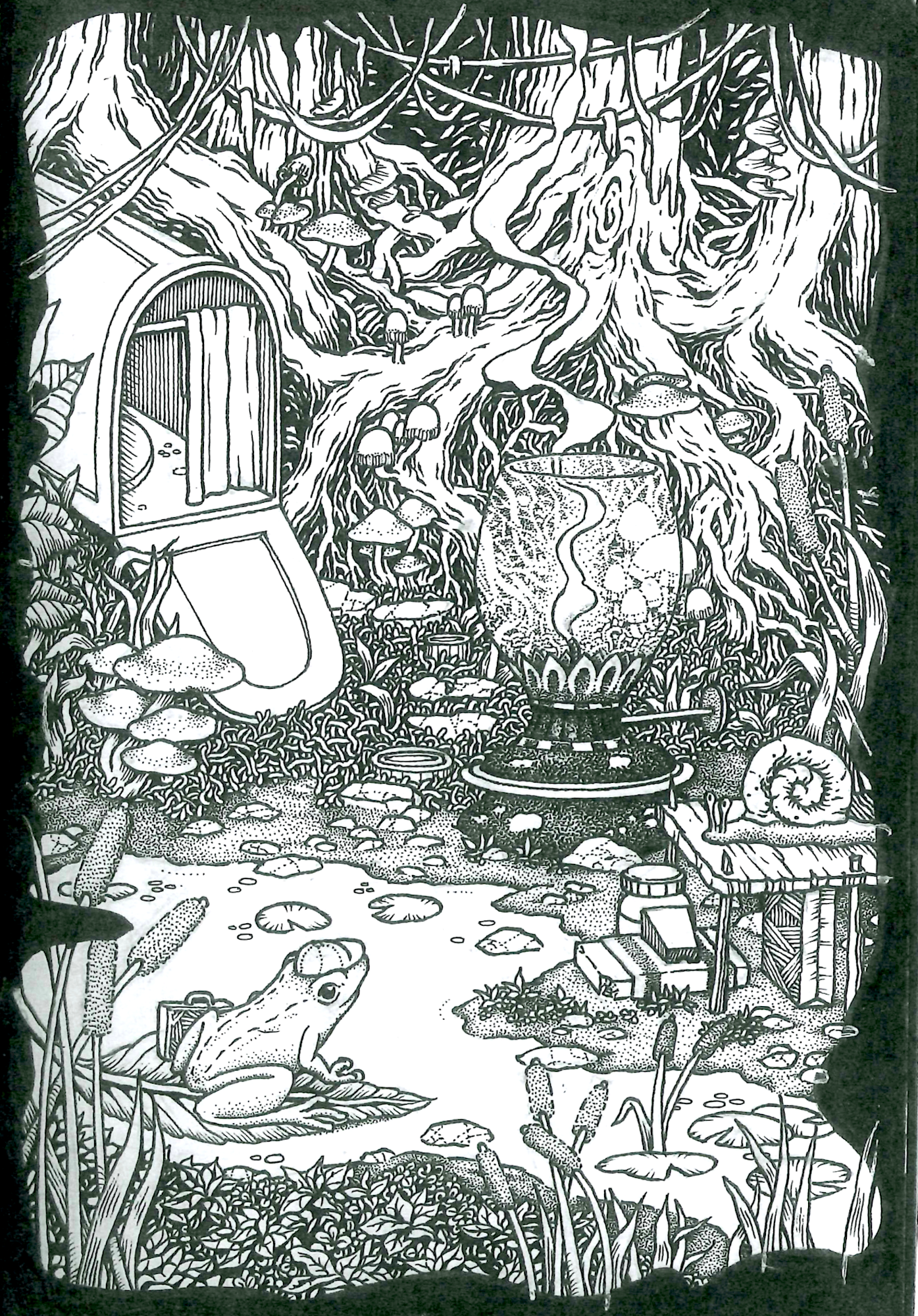
Art: "The Frog's Return"
By Sophia Kurtz
On the 18th day, the mangroves wailed. Something nacreous had filmed my sight, or everything it saw that day, and perhaps it was this privy that made their dirge familiar to me. More likely, it was my time spent there. With nothing but my mind's company at a place where everything breathes and very little thinks, I'd begun to believe myself the lead in the forest's understory.
Because I was staring at my hands, I'd chalked the first couple wails up as wind catching in the hollow of a bark to form a tunnel. I did this at times when my legs knew nowhere else but the way north well enough that my mind decided it could rest some. I'd start to a fallen branch or a rock in my path and find my palms still outstretched, my head lowered towards them. When I got to where the mangroves were, this became a luxury I couldn’t afford. I was surrounded by exposed root, constantly tripping. All the green was out of my reach—these trees were much taller than the ones beginning to grow at the edge of the region.
I was looking at my hands to check if they were glistening like all else, blinking some to try and clear it. It didn't feel quite as woolly as fog does. The film made everything stark. It made me miss fresh snow under a naked, morning sun and you. The tears formed above the nacre, and didn't wash it away. I was still unaccustomed to the sounds of this place; so unlike the chorus of lights and many voices overlapping of home, always on. Each sound here was its own, with a resounding start and finish. My every thought was forced whole.
I heard the third wail and it stood alone. I thought of that play you took me to decades ago about a newfound world that had lost all its record of history. The main character, recently landed on the planet, struggled to understand the people without the knowledge of what made them. (Afterwards, you told me this character reminded you of me—both voyagers. I didn't tell you the similarities ended there as we'd just met not more than three weeks prior and your hair smelled like honey.) In the third act, one of the players forced a sound through his lungs, a braying thing, to mimic the cadence of a punch line to a joke the group of them were attempting to recall. You were the only person in the theatre who laughed at it. Obnoxiously. You were convinced it was repeated just for you, because you loved it so much.
I didn't tell you then that I didn't find that moment all that funny. To me, the bray carried a certain sadness that filled me with dread. I didn't tell you because I didn't completely understand it myself back then.
Not too long after that third wail and only after this memory was whole, the edges that shaped your face faded with that memory of you. I was left to grasp the loss—mine, that player's, now the mangroves' too.
When I finally looked up, the faces, carved into tree trunks by time and pecking birds, were awake. Whorls of eyes were spinning slowly.
I could only blink. I was surrounded by nothing but them. The roots of the mangroves left little space for anything else to grow, anything else that could cut through hard rock to chase sunlight.
While I balked, three of the trunks unfurled their roots. I had to jump from where some of them slithered to shrug off dry dirt. They shivered, not just their leaves—trunk and all, shedding bits of bark to reveal bright red and smooth skin underneath. I watched the wood chips fall.
Earlier, having fallen to my knees a second time that day, I saw through what appeared a makeshift curtain of trellises to find several beetles rolled onto their backs staring up at the oysters clustered, clutching the roots of the mangrove closest to me. They were too small, and I hadn't a second to spare to my fascination, so I moved along as I pictured their eyes closed. Peeking into the nests of roots under every tree as I continued my trek, I was thrilled to find each consisted of denizens of their own. Some of the beetles were laid on hoards of pretty rocks, their purpose for collecting them, I could not know. They all seemed unconcerned by the possibility of one of the oysters, easily thrice their size, landing on them. A similar insouciance was afforded to their homes reshaping, chips falling around them.
I missed the metamorphosis: smooth wood recasting to sinewy stuff. When I returned from thought, three of the trees had trunks that looked like they could bend.
Those were the only, among all that were around her , that took antic life languidly. Their outsides looked composed. Unlike their insides, chattering in time with my bones to the chill of this place. Beneath the ground, timed tremors gave the rhythm of the beasts away. The nacre jostled about with dirt and rock as fine sand might. Individual grains melted into silk threads all around me. My vision, for a second split, became occluded to many wisps I couldn't blink away, before clearing (or blurring to normal) as the nacre that coated it twisted to strings, and was dragged away.
I watched the shimmery stuff strip off everything, to make for the three trees in front of me, and like a misplaced needle piercing the skin under a nail, the threads crawled into the trees through their roots.
I felt their next howl beneath my belly. The iridescent strands, bright under the top-most layer of their fresh skin, cured the remaining nature-marked imperfections on the trees' surfaces, molding bumps to fill crevices and turning clipped branches to torso to stretch the trees to stand taller than they already were.
Their eyes, bejewelled now, of red deeper than that along their flesh, found mine. Some sun broke through the canopy of the still-rooted trees to cast them and with the bit of spare light, I could see pearly swirls underneath the glassy parts of their eyes, moving in pace with everything else. I wasn't sure if my presence as their interloper inspired curiosity or rage, but did not have the moment to make the thought whole—their roots, worm-like and too large, harrowed the ground, surfacing the wet soil from deep beneath the rock bed to free nascent parts of them.
The roots crawled to two or more of its kind, trees assuming ambulation with the help of feet (the size of forearms and growing still, to torsos and growing still) forming from webbed, braided, twined roots.
Running was out of question. The still sessile trees shivered along, their branches stretching to meet other branches so they can wall me in.
The Walking trees approached slowly. Their fifth sound was a song of sorts. Not more pleasant than the braying thing for its take on a melody—a hummed altitonant A-HAH-A of all and nothing all at once. I had no desire to move, convinced this song was for me. Their march simply added to the thrum of their insides chattering and I started to find their presence soothing. The light had followed them to me and up close, the rims around their eyes seemed to curl into abyss.
(The part of this story I have never been brave enough to tell you is that, in that moment, I had given into giving up. The tracker pointing north hadn't moved in hours and I could not see out in the distance to find a wreck. I had lost all that kept me warm and all that kept me cool by then. The natural running water was fresh, but tasted all wrong. Their glowing eyes promised respite.)
The tumult of their first touch—a hand of twisted branches on my shoulder—forced the muscles on my face to unclench. My neck slackened, head fell back, and I stared at the parts of the sky I could see, sure I'd died. I hadn't, knew only for the sting of fresh droplets pelting onto my naked eyes. You loved the rain. I thought of all the times you described petrichor to me, merely as concept: must, dirt, rot coming alive at the touch of sustenance or something to that effect. I realized this thought came to me because I smelled it exactly as you described it, yet pleasant. I fought my muscles to return to me because I wanted to tell you all about it.
Liquid silk was breaching the pores where the trees, three stacked ersatz hands, held me. I felt layers of skin separating to grant way to electricity and with it came their song. I forgot to worry after the state of the careless critters' homes of root and shiny rocks. I began to miss you.
By chance, the silks sparked a knot behind my neck I'd grown accustomed to and eased it and that lack of ache was enough to return me to my body. I pulled my neck to its natural position and found myself facing the pitchy eyes of one of the beasts.
With mettle I did not know I harboured still, I screamed.
Aesha is most inspired by nature, weird looking trees in particular, and interactions between strangers in her city, Toronto, where she's surrounded by her favourite people, the love of her life, and her Bobo. She is new to writing, this being her first ever submission.